

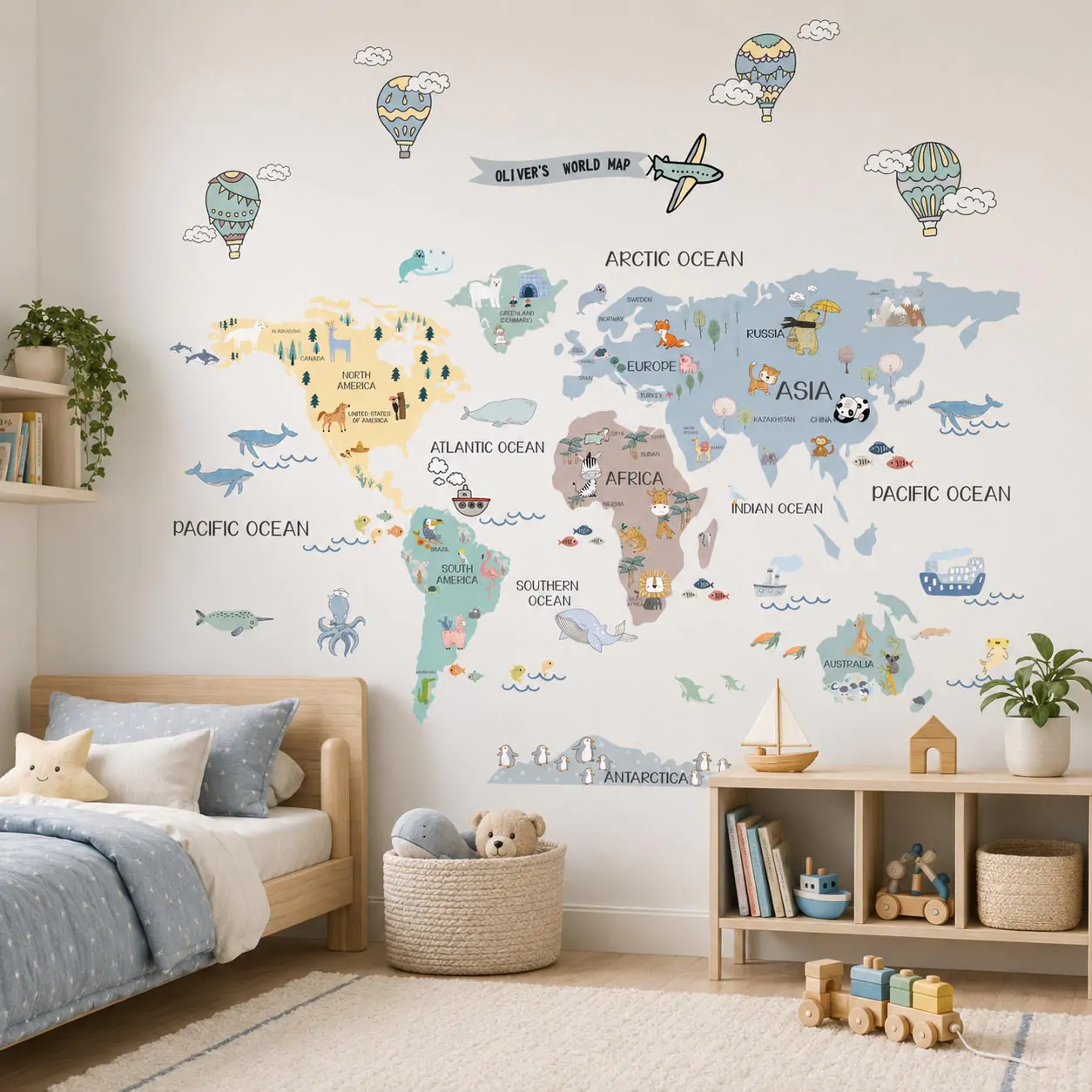
A world map for kids is both decoration and education at once: it fills a wall beautifully, then quietly starts teaching — continents at breakfast, oceans before bed, “where do penguins live?” on a rainy afternoon. This guide covers everything we’ve learned designing educational map decor for children: a kid-friendly tour of the continents, easy activities that build a daily geography habit, an honest comparison of every map format, and how to choose the right map for your child’s age.
The World at a Glance: 7 Continents for Kids
Before choosing a map, it helps to know what your child will discover on it — one continent, one big idea, and one animal at a time:
Seven continents, five oceans, one wall. A good children’s map turns this list into a picture your child revisits every day — which is exactly why the format you choose matters.
10 Simple Activities That Turn a Map into a Daily Habit
A map only teaches if it gets used. These games need no printouts, no prep, and no patience your child doesn’t have:
- Animal safari (ages 2+): “Find the elephant. Now the whale.” The friendliest possible introduction to continents.
- Continent of the week (ages 3+): One continent, named daily at bedtime. Seven weeks later, your child knows the shape of the world.
- Colour hunt (ages 3+): “Point to something blue. What is all that blue called?” Oceans, discovered.
- Where we live, where they live (ages 4+): Mark home. Then find grandma’s city, a friend’s country, tonight’s storybook setting.
- Weather reporter (ages 4+): “It’s summer here — point to where it’s winter right now.” Seasons suddenly make sense.
- Journey tracing (ages 5+): Finger-walk from home to anywhere. Plane or boat? Which oceans do you cross?
- Dinner table geography (ages 5+): Tacos tonight? Find Mexico. Pasta? Find Italy.
- Alphabet atlas (ages 6+): Find a place starting with A. Then B. A twenty-minute game that teaches for years.
- News and sport spotting (ages 7+): World Cup, Olympics, tonight’s news — locate it together.
- Capital quiz-master (ages 8+): Let your child quiz you. Being the teacher is the fastest way to learn.
World Map Formats Compared: Which One Is Right for Your Child?
Here’s the honest comparison of every format — including the ones we don’t sell:
Wall decals — the everyday teacher
A fabric wall decal is the format we believe in most for home use. A kids world map decal lives at child height, covers a generous stretch of wall, can be touched freely, and never needs tidying away. Textile decals are also the most forgiving format: no frame, no glass, no pins — nothing to break. When you move or redecorate, they peel off cleanly and go with you. Browse our full collection of world map wall decals to see the range.
Posters — affordable but fragile
The cheapest way to get a map up, and a fine place to start. Trade-offs: paper tears under curious fingers, most posters are designed for adult reading distance, and framing one behind glass puts it out of reach — defeating the purpose for a young child.
Puzzle maps — brilliant hands-on practice
A world map puzzle for kids is a fantastic supplement for ages 3-6: assembling continents builds fine motor skills and shape recognition. The limit: a puzzle lives in a box between uses. A companion to a wall map, not a replacement.
Globes — the true shape of the world
Globes show what flat maps can’t: the world is round. Lovely from age 5+, frustrating for toddlers — small details, easy to knock over, hard to study up close.
Map rugs — geography underfoot
A washable world map rug puts the world at floor-play level — wonderful for toddlers, and a favourite classroom gathering spot. Rugs pair beautifully with a wall map: one to crawl over, one to grow up pointing at.
Printable maps — perfect for activities, poor as decor
A printable world map for kids shines for one-off projects: colouring continents, marking a trip, homework. As wall decor, prints fade and curl within a season. Use printables for hands-on activities, and something durable for the wall.
Choosing a World Map by Age
Ages 1-3: big shapes, friendly details
Toddlers read pictures, not maps. Continents in bold colours, animals big enough to point at — “where’s the lion?” is the whole curriculum, and it’s exactly right. Minimal text, maximum warmth, hung at their eye level. A soft design like our World Map Custom Sky Textile Decal earns its keep here: no glass, nothing sharp, and it survives enthusiastic pointing.
Ages 3-5: naming and sorting
Preschoolers attach names to shapes: this is Africa, penguins live down there. Keep the friendly visuals, add clear continent labels. The golden age for pairing formats — wall map for daily exposure, puzzle for hands-on practice. It’s the approach Montessori classrooms have used for a century.
Ages 6-9: countries, capitals, and questions
School-age children are ready for detail: borders, capitals, flags. A world map with countries becomes genuinely useful for homework — and for the endless “which country is bigger?” debates. A design like our World Map Custom Dreamy Textile Decal for Kids Room makes the upgrade from picture-led to detail-led feel natural.
Ages 10+: the map becomes a tool
Older children use maps like adults do — locating the news, planning trips, following favourite athletes home. The habit built in the nursery years pays off exactly here.
What Makes a Great World Map for Kids: A 4-Point Checklist
1. Accuracy with warmth
True continent shapes and honest proportions, warmed up with illustration — animals in real habitats, landmarks where they belong. The test: can your child find something they love in five seconds, and is what they find true?
2. Safe, non-toxic materials
A child’s map gets touched — that’s the point — so it should be made accordingly. Look for PVC-free, non-toxic materials, especially for nursery walls. Every Dos Junior map is printed on breathable fabric textile rather than plastic vinyl for exactly this reason. Whatever brand you choose, check the material honestly: “for kids” on a label doesn’t automatically mean child-safe in the making.
3. The right size, hung at the right height
Bigger is genuinely better: details readable from a distance, continents traceable with a whole arm. For most bedrooms, 100–150 cm wide is the sweet spot. Hang it lower than instinct says — centre at your child’s eye level. A removable decal makes this painless: low now, higher as they grow.
4. Room to grow, not a trend to outgrow
Children outgrow trend decor fast; they don’t outgrow the world. A well-chosen map in calm, timeless colours survives every redesign from nursery to age ten. That’s the philosophy behind everything we design: not chasing what’s trending, but making educational pieces a child grows with.
Where to Put a World Map (Room by Room)
The nursery: above the changing table or beside the rocking chair — where you’ll narrate to your baby anyway. Soft, neutral tones suit sleep spaces. Browse our nursery wall decals for calm, baby-safe designs.
The playroom: the map’s natural habitat — floor-play height, where cars drive to Australia and dinosaurs migrate to Asia. See our kids room wall decals for playful, learning-led themes.
A shared room: maps are the great neutral theme — there is no “boys” or “girls” version of the world. Our shared room wall decals are chosen to suit any child, any age.
Homeschool corners and classrooms: a world map for the classroom anchors any learning space — large formats for group pointing, a washable map rug as the gathering spot, and fabric decals for rented rooms that must come off cleanly at year’s end.
Frequently Asked Questions
What age should a child get a world map?
There’s no “too early.” Babies benefit from parents narrating over a nursery map, and toddlers from about 18 months genuinely engage with pointing games. The absorbent early years are when casual exposure does its best work.
What’s better for a child’s room: a poster or a wall decal?
For young children, a fabric decal has the practical edge: no glass, safe to touch, removable without damage, and readable from across the room. Posters are budget-friendly but fragile and usually designed for adult reading distance.
Are world map wall decals safe for a nursery?
Quality ones are — check the material. Ours are printed on PVC-free, non-toxic textile fabric specifically because they’re made for rooms where children sleep. Avoid cheap vinyl with no material information.
Should the map show countries or just continents?
Match it to age: continents and animals under five, countries and capitals from school age. For one map to span both, choose clear continents with light country detail — or start friendly and upgrade around six.
Is a puzzle map or a wall map better for learning?
They teach differently: puzzles build shape recognition through play; wall maps build lasting familiarity through daily exposure. Choosing one? Choose the wall — it teaches every day without leaving a box. Ideally, both.
How do you remove a wall map decal without damaging paint?
Peel slowly from one corner at a low angle — textile decals leave no residue and won’t pull paint. We wrote a full step-by-step guide: how to remove wall decals.
Start Their World Journey
You don’t need a curriculum to raise a little geographer — one good map at their height, and a habit of pointing at it together. Explore our full collection of world map wall decals for kids — non-toxic textile fabric, made to order, shipped quickly from our US studio. To complete the theme, pair your decal with our World Map Wall Hanging and the Washable World Map Rug for Kids, or read why every child’s room needs a world map in our earlier guide.