

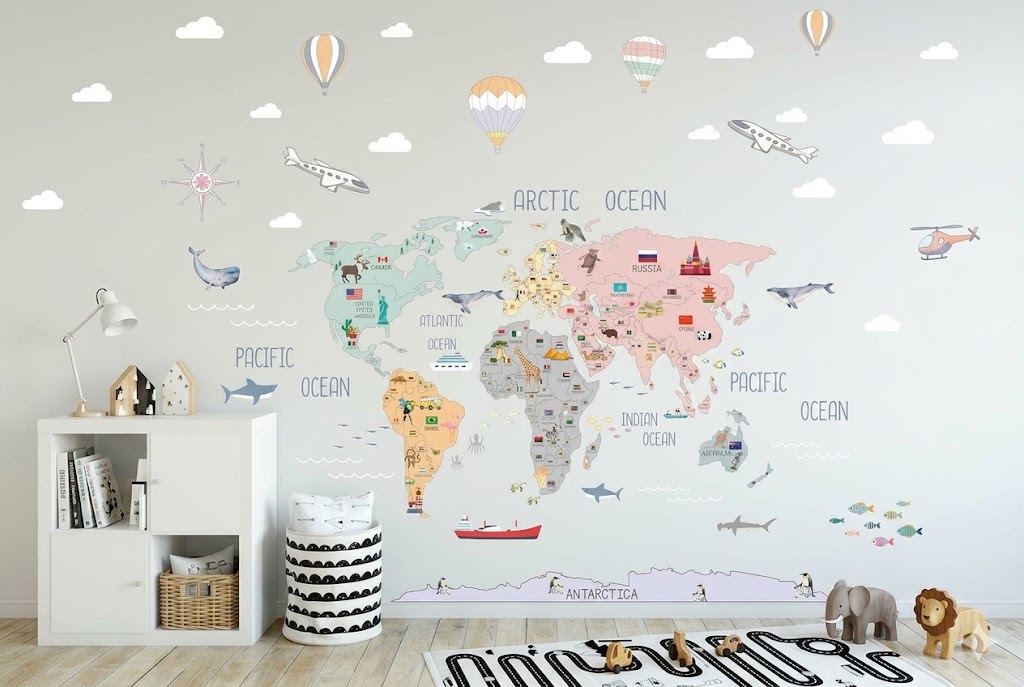
A world map illustration fundamentally transforms a child’s room into an interactive learning environment, significantly increasing early geographical awareness. By introducing continents, oceans, and diverse habitats through engaging visual storytelling, children begin to comprehend the vastness of our planet. This foundational exposure lays the groundwork for advanced cognitive development and spatial reasoning skills. Throughout this comprehensive guide, we will thoroughly explore the cognitive benefits of geographical designs, the critical health advantages of utilizing unprocessed organic cotton materials, and the versatile applications of multifunctional textiles in modern nurseries.
What are the cognitive advantages of early geographical exposure?
Introducing children to geographical concepts during their formative years accelerates their cognitive processing speeds and broadens their intellectual horizons. The human brain, particularly during the critical developmental stages of early childhood, acts as a highly receptive sponge that effortlessly absorbs complex visual information. When a world map illustration is prominently displayed in a child’s primary play area, it serves as a constant, passive educational stimulus. This continuous exposure allows children to subconsciously internalize the structural layout of the globe long before they encounter formal geographical education in a classroom setting.
The cognitive advantages of this early exposure manifest in several distinct ways. Firstly, children begin to develop a robust sense of spatial awareness. They learn to estimate distances between different landmasses, understand the concept of boundaries, and recognize the proportional sizes of various countries and oceans. Secondly, early geographical exposure significantly enhances vocabulary acquisition. As parents interact with the map, pointing out different regions, oceans, and specific animal habitats, children are introduced to a rich array of new, descriptive terminology.
Furthermore, engaging with a world map illustration fosters critical thinking and early problem-solving skills. Children naturally begin to ask fundamental questions about the world around them, such as why certain animals inhabit specific continents or why oceans separate different landmasses. Answering these questions helps children establish logical cause-and-effect relationships, laying a solid foundation for future scientific inquiry. By integrating educational elements into their daily environment, parents can seamlessly blend playtime with foundational academic learning, ensuring that cognitive development occurs in a stress-free and highly engaging manner.
How does a world map illustration support visual discrimination skills?
Visual discrimination is the fundamental cognitive ability to recognize details in visual images, allowing children to identify and categorize distinct shapes, colors, and patterns. A well-designed world map illustration is an effective tool for honing these crucial observational skills. The complex layout of the continents, the intricate borders of various countries, and the diverse color palettes used to represent different geographical zones require the developing brain to carefully process and differentiate between multiple visual stimuli simultaneously.
When a child visually navigates across a world map illustration, they are actively practicing their ability to focus on specific details while ignoring irrelevant background information. This targeted visual focus is an essential prerequisite for later academic tasks, particularly reading and writing, which demand precise visual tracking and letter recognition. The distinct shapes of continents, such as the curved coastline of South America or the fragmented islands of Southeast Asia, present distinct visual puzzles that challenge and refine a child’s spatial perception.
To maximize the development of visual discrimination skills, the design of the map should incorporate the following elements:
- High-contrast color blocks that clearly separate distinct landmasses and bodies of water.
- Detailed, easily recognizable animal illustrations placed accurately within their native geographical habitats.
- Clear, legible typography that labels major oceans and continents without overcrowding the visual space.
By regularly engaging with these complex visual layouts, children improve their visual memory retention. They learn to recall the specific placement of elements, such as remembering that penguins are located at the bottom of the map in Antarctica. This continuous exercise of visual discrimination not only enhances their geographical knowledge but also significantly fortifies their overall cognitive architecture, preparing them for more complex analytical tasks in their educational journey.
Why is organic cotton the best material for children’s play areas?
The physical environment where a child plays and interacts with their educational tools must prioritize health, safety, and comfort. The skin structure of individuals in infancy and early childhood is significantly thinner, more porous, and highly permeable compared to adults. This biological reality dictates that the chemical composition of any material present in the play area can be directly absorbed by the body. Therefore, any textile featuring a world map illustration intended for a child’s room must absolutely be produced from raw, unprocessed, and entirely organic cotton to guarantee a completely safe tactile experience.
Factory-made synthetic fabrics, such as polyester or acrylic, generate high amounts of static electricity through friction and lack basic air permeability. This creates a harsh environment that can clog pores, trap sweat against the skin, and provoke severe dermatological issues like eczema or contact dermatitis. In stark contrast, organic cotton offers a naturally breathable cellular structure that continuously regulates body temperature, traps excess moisture, and maintains a healthy skin flora without introducing toxic chemical residues.
The structural differences between natural and synthetic textiles highlight the necessity of organic choices:
- Air permeability: Organic cotton offers high capacity breathing, whereas synthetics trap air.
- Chemical footprint: Natural cotton relies on safe, water-based dyes, avoiding petroleum derivatives.
- Static generation: Organic fibers remain static-free, while synthetics generate intense friction.
- Allergen resistance: Unprocessed cotton naturally repels dust mites and prevents bacterial accumulation.
Furthermore, the dyes utilized in creating a vibrant world map illustration on organic cotton must be eco-friendly, water-based, and strictly certified to be free of heavy metals. When children inevitably bring these textiles to their mouths or spend hours lying face-down on them, certified organic materials ensure that zero harmful chemicals are released into their delicate respiratory tracts, providing parents with absolute peace of mind.
Which multifunctional designs serve as wall decor and floor mats?
Modern parenting paradigms and minimalist lifestyle philosophies strongly advocate against restricting nursery items to a single, short-lived function. A sustainable and highly practical approach requires selecting products that can seamlessly adapt to a child’s evolving needs across different developmental stages. In this context, raw cotton fabrics equipped with discreet hanging apparatuses on the upper corners offer high-level functional versatility. These innovative textiles can effortlessly transition between serving as a protective play surface and transforming into a captivating educational wall tapestry.
During the early crawling and toddler stages, a textile featuring a world map illustration can be laid flat on the ground to serve as a designated, safe exploration station. The soft, organic texture provides a comfortable area for tummy time and initial mobility exercises. As the child grows, gains balance, and begins to expand their physical territory, this exact same textile product can be elevated and secured to the wall at the focal point of the room. This seamless transition instantly updates the room’s aesthetic and introduces a vertical learning dimension without requiring any structural changes or new furniture purchases.
The integration of multifunctional textiles into the nursery environment can be executed through various practical applications:
- Utilizing the mat as a comfortable base for sensory play and structural building block activities.
- Hanging the fabric on an empty wall to serve as an interactive, visual backdrop for bedtime storytelling.
- Draping the textile over a reading nook or play tent to create a culturally immersive and cozy hideaway.
Experiencing a world map illustration in varying physical formats—first horizontally on the floor, then vertically on the wall—significantly reinforces a child’s psychological perception of object permanence and spatial relativity. Lightweight, easily adjustable textile decorations represent a highly effective formula for curating a dynamic, long-lasting, and educational space.
How do tech-free sensory play zones improve independent learning?
In an era dominated by ubiquitous digital screens and constant electronic stimulation, establishing tech-free zones within a child’s environment has become a critical pedagogical necessity. These specialized sensory areas are intentionally designed to be entirely free of digital devices, flashing lights, and artificial noises. The primary objective is to cultivate a serene atmosphere where children are encouraged to engage in independent, self-directed play using their innate imagination and analog materials. A minimalist approach to these zones ensures that the child is not overwhelmed by clutter, allowing them to focus deeply on high-quality educational resources.
At the very heart of these calming sensory zones, a large textile featuring a world map illustration serves as the foundational anchor. This visually rich yet completely silent material dictates the physical boundaries of the play area, providing the child with a distinct sense of ownership and security. Without the passive entertainment provided by tablets or televisions, children must actively engage their cognitive faculties to interact with the map. They trace the outlines of continents with their fingers, group wooden animal toys according to their correct geographical habitats, and construct elaborate, imaginative narratives based entirely on the printed illustrations.
The functional advantages of implementing a tech-free play zone centered around an educational textile are highly notable:
- It significantly increases a child’s attention span by eliminating rapid-fire digital distractions.
- It encourages the development of fine motor skills through tactile engagement with the organic cotton texture.
- It fosters deep emotional regulation, providing a quiet retreat where children can decompress from sensory overload.
- It promotes intrinsic motivation, as the child dictates the pace and direction of their own geographical exploration.
By prioritizing high-quality, analog materials over disposable plastic gadgets, parents create an environment that inherently respects and nurtures a child’s natural developmental trajectory. A tech-free zone anchored by a world map illustration is an invaluable investment in independent learning and cognitive focus.
What is the psychological impact of travel-friendly familiar textiles?
Maintaining a sense of routine and environmental familiarity is crucial for a child’s psychological well-being, particularly when navigating the disruptions associated with travel or relocating to a new home. Children thrive on predictability; sudden changes in their physical surroundings can often trigger anxiety, sleep disturbances, and behavioral regressions. A highly effective strategy for mitigating this travel-induced stress is the utilization of lightweight, portable nursery items that carry the scent, texture, and visual familiarity of the child’s primary safe space.
Unlike heavy, immovable nursery furniture or bulky standard carpets, a foldable textile featuring a world map illustration is a highly practical travel-friendly educational tool. Because it is crafted from thin, organic cotton, it can be easily folded into compact dimensions and packed into a standard travel bag. When a family arrives at a hotel room, a holiday rental, or a relative’s house, unpacking and laying out this familiar world map illustration instantly creates a recognized, secure play boundary. The child immediately identifies the familiar geographical patterns and the soft cotton texture, which acts as a powerful psychological anchor in an otherwise alien environment.
The implementation of portable, familiar textiles offers several distinct advantages for dynamic families:
- It drastically reduces the time required for a child to acclimatize to a new sleeping or playing environment.
- It ensures a consistently hygienic and clean surface, protecting the child from unknown floor contaminants in public accommodations.
- It provides a continuous, uninterrupted educational tool that bridges the gap between home learning and travel experiences.
- It empowers the child by assigning them the simple responsibility of folding and carrying their own designated play mat.
By integrating a world map illustration into a travel-friendly textile format, parents provide their children with a consistent source of comfort and cognitive stimulation, regardless of their geographical location in the real world.
What is the correct way to clean organic nursery textiles?
Maintaining strict hygiene standards for items frequently used in a child’s room is absolutely imperative. However, achieving this necessary cleanliness must not involve the deployment of aggressive, highly acidic, or heavily chemical-laden detergents. Raw, unprocessed organic cotton textiles demand a highly specific and gentle maintenance routine to preserve the integrity of their natural fibers. Adhering strictly to the recommended washing and drying protocols is essential to protect the vibrancy of the printed world map illustration while simultaneously extending the structural lifespan of the fabric for years of continued use.
The eco-friendly, water-based pigments utilized to print complex geographical designs onto cotton fabrics are highly sensitive to extreme temperatures. If exposed to intensely hot water, these non-toxic dyes can lose their molecular stability, resulting in premature fading and color bleeding. Therefore, when machine washing these specialized organic products, the water temperature must be strictly limited to a maximum of 30°C, and a delicate cycle must be employed. Furthermore, parents must actively avoid intensely perfumed chemical softeners or bleach alternatives, opting instead for natural, soap-based, and colorless cleaning agents that leave zero synthetic residue within the fabric’s pores.
To guarantee the longevity and pristine condition of a world map illustration printed on organic cotton, follow these fundamental care steps:
- Address liquid spills immediately by gently buffering the area with a damp microfiber cloth and natural soap; never use hard-bristled brushes that can tear the fibers.
- Avoid drying the textiles under direct, scorching sunlight, which can bleach the natural dyes; instead, lay them flat in a well-ventilated, shaded area.
- Eliminate fabric wrinkles by setting the ironing device exclusively to the lowest cotton temperature, ensuring the iron is only applied to the reverse, unprinted side of the textile.
Consistent, chemical-free maintenance ensures that the organic cotton remains remarkably soft over time, maintaining both its structural integrity and its educational aesthetic.
At what age should children use educational map textiles?
Children can begin interacting with a world map illustration from the early crawling stages, around 6 months of age. As they grow into toddlers and preschoolers, the cognitive benefits increase as they actively identify continents, animals, and colors, making it a long-term educational investment.
Do organic cotton textiles cause skin allergies?
No, they absolutely do not cause allergies. Fabrics produced from completely raw, unprocessed organic cotton without chemical synthetic dyes are hypoallergenic. They do not irritate the respiratory tracts of babies with sensitive skin and do not harbor dust mites.
Can a play mat be safely hung on the wall?
Evet, ürünün üst köşelerinde bulunan küçük kumaş duvar askıları kullanılarak minimum müdahaleyle asmak mümkündür. Çivi veya vida kullanmayı tercih etmiyorsanız, güçlü yapışkanlı kancalar kullanarak iz bırakmadan güvenli bir şekilde sabitleyebilirsiniz.
Is it safe to machine wash organic nursery mats?
Evet, güvenle makinede yıkanabilirler. Pamuk yapısını ve baskı kalitesini korumak için, en fazla 30°C sıcaklıkta hassas yıkama programında yıkanmalıdırlar. Ağartıcı içeren sert kimyasallar kullanılmamalı ve ütüleme işlemi tersinden yapılmalıdır.
Integrating a world map illustration into a child’s daily environment is a significant step toward fostering early geographical awareness and advanced cognitive development. By combining the interactive, visual learning of global continents with the undeniable health benefits of chemical-free, organic cotton, parents create an atmosphere that is both intellectually stimulating and physically safe. These multifunctional textiles effortlessly transition from comfortable floor play areas to captivating wall decorations, proving to be an indispensable asset for modern, tech-free nurseries. You are in the right place to discover eco-conscious and highly educational solutions for your home.
Explore organic cotton world map textiles designed to inspire early geographical awareness. Dos Junior