

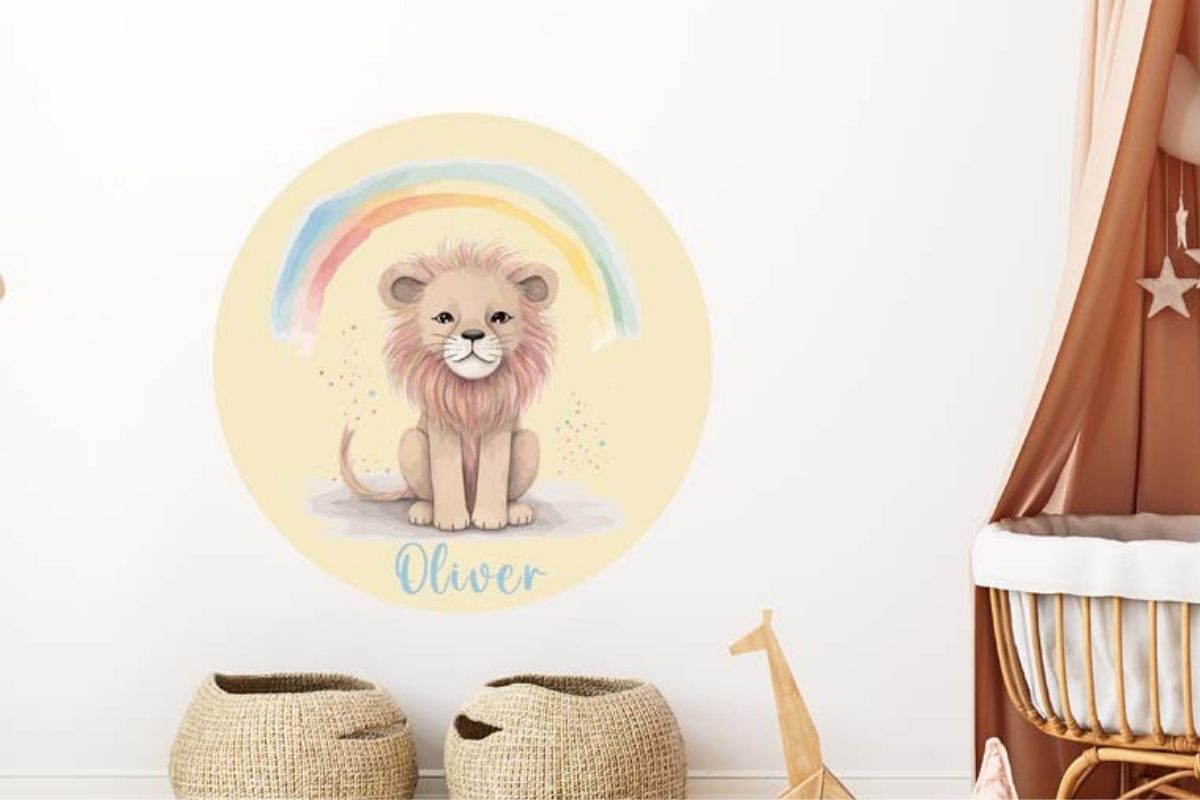
Safari wall decals for nursery rooms are the most practical way to create a fully themed jungle or savanna environment without paint, without a contractor, and without permanent wall damage. The best options use water-based adhesives and EN71-certified inks — the same safety standard applied to children’s toys — making them genuinely appropriate for a sealed room where a newborn sleeps up to 17 hours a day. This guide covers the key animal themes, material safety requirements, placement strategy, and how to choose safari decals that remain visually appropriate as the child grows from infant to toddler.
What are safari wall decals for nursery rooms?
Safari wall decals for nursery spaces are pressure-sensitive vinyl or fabric stickers featuring animals native to African savannas and tropical jungles — lions, elephants, giraffes, zebras, monkeys, and tropical birds — designed to adhere to smooth painted walls without nails, screws, or permanent adhesive. They peel off cleanly when repositioned or removed, leaving no residue on properly cured paint surfaces.
The format sits at the intersection of decoration and developmental tool. Research in early childhood visual development confirms that infants begin distinguishing animal shapes and large organic forms by 4–6 months of age, when color receptors in the retina become sufficiently mature. Safari-themed wall art placed within the infant’s visual field — at 40–80 cm from the floor for a crawling baby, or at 100–120 cm for a standing toddler — provides consistent visual stimulation that supports object recognition and vocabulary development during daily interactions.
Key characteristics that define a quality safari nursery decal:
- Substrate: Cast vinyl or fabric film — more dimensionally stable and lower-emission than calendered vinyl
- Adhesive: Water-based acrylic — zero meaningful VOC off-gassing after 48-hour cure
- Inks: EN71-3 certified — confirms no heavy metal migration from surface coating
- Finish: Matte — reduces light reflection that can overstimulate infants during sleep
Dosjunior safari wall decals meet EN71 ink certification standards and use water-based adhesives — the two criteria that matter most for a baby’s sleep environment.

Which safari animals work best for nursery wall decals?
The choice of animal motifs in safari decals for walls affects both the room’s visual balance and its developmental utility. Not all safari animals function equally well across different wall positions, room sizes, or age stages.
Large statement animals for focal walls
Elephants and giraffes are the most effective anchor animals for a focal wall behind the crib. Their vertical shapes — particularly the giraffe’s long neck — draw the eye upward and make low-ceilinged rooms feel taller. A single large giraffe decal sized between 80–120 cm tall creates a focal point equivalent to a framed art piece, without the glass-breakage risk of hanging art above a sleep area.
Elephants in profile carry additional developmental value: their distinctive silhouette is recognisable to infants at earlier developmental stages than animals with less distinctive outlines. A 2019 study in Infant Behavior and Development found that infant visual attention fixates on high-contrast curved outlines — the elephant’s rounded body and trunk provide exactly this type of edge contrast.
Accent animals for secondary walls
Lions, zebras, and tropical birds work best as accent pieces on side walls — sized between 15–40 cm — creating visual movement around the room without competing with the focal wall. Zebra stripes provide built-in high contrast, making them particularly effective during the first 3 months when the infant’s color vision has not yet matured.
Monkeys and parrots introduce warm color: reds, yellows, and bright greens that become increasingly engaging after the 5-month color vision milestone. Placing these on the wall the baby faces during feeding or awake time maximises the developmental exposure.
Are safari wall decals safe for a baby’s nursery?
Yes — when manufactured with the right materials. The safety question around safari animal decals for walls comes down to two variables: chemical emissions and physical installation security.
Chemical safety: VOCs and certifications
Standard PVC vinyl decals can off-gas diethylhexyl phthalate (DEHP) and other plasticizers at concentrations exceeding the European Chemicals Agency’s safe indoor threshold of 0.1 mg/m³ for children’s environments. This off-gassing is highest in the first 7–14 days after installation and occurs continuously at lower levels for months afterward in poorly ventilated rooms.
The certifications that verify chemical safety in safari nursery wall decals:
| Certification | What it tests | Pass threshold |
| EN71-3 | Heavy metal migration from inks | ≤2 mg/kg for antimony |
| REACH (EU) | 200+ restricted hazardous chemicals | Full substance restriction |
| OEKO-TEX 100 | Harmful substance in textile substrates | pH 4.0–7.5 for baby products |
After confirming certifications, ventilate the nursery for a minimum of 24 hours after applying any wall decal, regardless of the stated VOC level. This eliminates even trace adhesive cure emissions before placing the baby in the room.
Physical safety: installation rules
- Never apply any item heavier than 500g directly above the crib without stud-mounted hardware
- Safari decals under 3g per 10 cm² of surface area are inherently lightweight — no structural risk
- Apply only to paint cured for a minimum of 28 days to ensure clean removal without pulling the paint layer

How to apply safari decals for walls without mistakes
Application errors — bubbles, edge lifting, misalignment — cause the majority of avoidable failures with peel-and-stick wall decals. A systematic process eliminates all three.
Surface preparation
Clean the target wall section with a lint-free cloth dampened with 70% isopropyl alcohol. Allow to dry for a minimum of 15 minutes. Any trace of grease, dust, or cleaning product residue reduces adhesion by up to 60%, according to pressure-sensitive adhesive technical guidelines. Do not apply to walls painted within 28 days — fresh latex paint remains partially soluble and will bond to the adhesive layer, causing damage on removal.
Room temperature matters more than most parents realize. Water-based acrylic adhesives lose permanent tack below 15°C. Application in cold utility rooms or conservatories in winter can result in decals that appear secure but detach within days. The optimal application range is 18–26°C at below 60% relative humidity.
Step-by-step application
- Plan the arrangement using painter’s tape mockups before peeling any backing
- Photograph the arrangement with your phone — review before committing
- Peel the backing slowly at a 45° angle, not straight back
- Position the decal lightly against the wall before pressing — most quality decals allow 30–60 seconds of repositioning
- Smooth from the centre outward using a flat-edged card, never your fingernail
- Do not press edges last — edge adhesion completes naturally as the centre is smoothed
Removing safari nursery wall decals cleanly
When the time comes to update the room, use a standard hair dryer at medium heat held 10–15 cm from the surface for approximately 20 seconds per 30 cm² section. Warm adhesive releases progressively without tearing paint. Peel at a 45° angle while the surface is still warm.

Safari wall decals for nursery: style combinations that work
Safari animal decals for walls achieve their best visual result when combined with a coordinated color palette rather than applied to whatever existing paint is on the wall. The choice of background color determines whether the safari theme reads as vibrant and playful or sophisticated and calming.
Earth-tone palettes for a modern safari nursery
The strongest current trend in safari nursery design pairs animal decals with warm neutral backgrounds: terracotta, dusty sage, warm ivory, and soft ochre. These tones perform two functions simultaneously — they complement the natural browns and golds of safari animal imagery, and they align with the muted, organic palette that dominates contemporary nursery design.
Pinterest’s 2023 trend analysis identified “earthy safari nursery” as one of the platform’s fastest-growing interior searches, with saves increasing 94% year-over-year. This growth reflects a broader movement away from primary-color children’s decor toward palettes that function as sophisticatedly as adult interior design.
Dosjunior safari wall decals are designed in earth-tone colorways specifically to coordinate with this palette trend — terracotta elephants, sage-toned botanical accents, and warm ivory giraffe silhouettes that work against both white and colored wall backgrounds without requiring a repaint.
High-contrast black and white for newborn-focused rooms
For parents decorating before the baby arrives, or for rooms designed primarily for the newborn phase, a black-and-white safari theme is developmentally optimal. Monochrome zebra stripes, black silhouette elephants against white, and high-contrast giraffe outlines provide the edge contrast that newborn visual systems respond to most strongly.
This palette also has a practical longevity advantage: it reads as graphic and design-forward rather than overtly childish, meaning the aesthetic transitions naturally into a toddler room without requiring a complete redecoration at 12–18 months.

How to plan safari wall decal placement for a nursery
Placement planning separates a professionally designed nursery from a randomly decorated one. The same set of safari animal decals for walls will produce dramatically different results depending on where and how they are positioned.
The single most common placement mistake is installing everything at adult eye level — approximately 150–160 cm from the floor. This positions the entire display above the baby’s visual field for the first 12–18 months of life.
Developmentally correct placement heights:
| Phase | Baby’s eye level | Optimal decal height |
| Newborn (lying in cot) | Directly above, 30–50 cm | Ceiling or 30 cm above cot rail |
| Crawling (6–10 months) | 30–50 cm from floor | 40–70 cm from floor |
| Pulling to stand (9–14 months) | 60–80 cm from floor | 60–100 cm from floor |
| Walking toddler (12–24 months) | 80–100 cm from floor | 80–130 cm from floor |
A practical approach: install the largest anchor animals — the giraffe or elephant — at 100–130 cm to the centre of the decal. Then scatter smaller accent animals (zebras, birds, monkeys) at 50–80 cm from the floor. This creates a tiered visual composition that serves both adult viewing and infant developmental engagement simultaneously.
For a cohesive safari nursery using dosjunior wall decals, a three-wall composition works well: large focal animal on the crib wall, medium accent animals on the side walls at crawling height, and smaller botanical or bird elements near the ceiling for nighttime visual interest.
Frequently asked questions
Are safari wall decals safe for a newborn’s room?
Yes, when they carry EN71-3 ink certification and use water-based adhesives. These two specifications confirm no heavy metal migration and zero meaningful VOC emissions after 48 hours of curing. Ventilate the nursery for 24 hours after application before placing the baby in the room, regardless of the stated safety rating.
Do safari nursery wall decals damage paint when removed?
No, provided the paint has cured for at least 28 days before application and a hair dryer is used during removal. Heat the adhesive at medium power for 20 seconds per 30 cm² section, then peel at a 45° angle while warm. Flat and matte paint finishes require extra care — test a small corner first.
What size safari wall decals work best for a nursery?
For a focal wall behind the crib, anchor animals sized 80–120 cm tall create the strongest visual impact. For side walls and accent placements, 15–40 cm elements provide visual movement without competing with the focal piece. Mix scales deliberately — one large, three to five medium, and several small — for a professionally layered result.
Are safari wall decals worth buying compared to a painted jungle mural?
Yes, for most parents. Quality safari decals typically cost £15–£70 per set versus £250–£900 for a professional mural. They install in under 30 minutes, require no drying time, cause no wall damage, and can be updated as the child grows. A mural outperforms decals only on heavily textured walls where adhesion is inconsistent.
Conclusion
Safari wall decals for nursery rooms offer a combination of developmental benefit, material safety, and design flexibility that no other wall treatment matches at the same price point. Choosing EN71-certified products with water-based adhesives, applying them to properly cured paint at the child’s developmental eye level rather than adult eye level, and combining large anchor animals with smaller accent pieces produces a result that serves the room from newborn through toddler years without redecorating.