

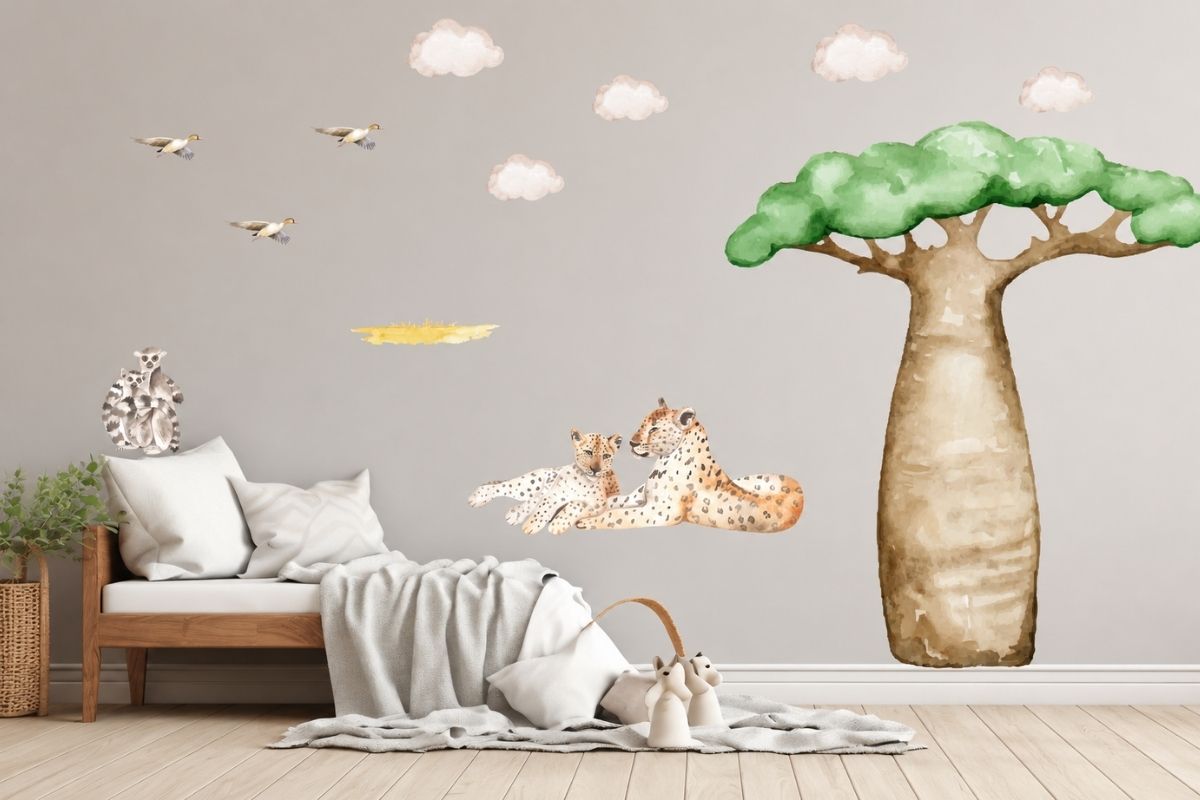
Nursery wall art stickers are one of the most parent-friendly ways to transform a bare room into a warm, imaginative space — without paint fumes, wall damage, or a contractor. The best options today are manufactured with low-VOC or zero-VOC adhesives, making them genuinely safe for the air a newborn breathes 16 or more hours a day. This guide covers everything from material science and safety certifications to style categories, placement strategy, and how to remove decals cleanly when the time comes.
What are nursery wall art stickers and why do they matter?
Nursery wall art stickers are pressure-sensitive vinyl or fabric decals designed to adhere to painted drywall, plaster, or smooth surfaces without nails, screws, or permanent glue. They peel off cleanly — leaving no residue and no wall damage — which makes them the default choice for renters and for parents who want flexibility as the child grows.
The format matters more than it might first appear. A nursery is a sealed, low-ventilation space where a newborn sleeps up to 17 hours per day, according to sleep research published by the American Academy of Pediatrics. Any material introduced into that room — textiles, furniture, paint, wall art — contributes to the indoor air chemistry the baby inhales continuously. Low-quality vinyl decals can off-gas volatile organic compounds (VOCs) for weeks after application. High-quality products, by contrast, test at or below the 0.01 mg/m³ threshold considered safe for sensitive respiratory systems.
Key properties that define a quality nursery wall art sticker:
- Material: Cast vinyl or fabric-based films release fewer plasticizers than calendered vinyl.
- Adhesive: Water-based acrylic adhesives produce no measurable VOC off-gassing after 48 hours of curing.
- Ink: UV-cured or water-based inks rated EN71-3 (toy safety standard) confirm no heavy metal migration.
- Backing: Silicone-coated release liners prevent adhesive degradation during storage.
Dosjunior nursery wall decals are produced with water-based inks and tested to EN71 standards — the same certification framework applied to children’s toys — placing them in the highest safety tier available for nursery decor.
Are nursery wall stickers safe for babies? Understanding VOCs and certifications
This is the question every parent types into a search bar before buying, and it deserves a precise answer rather than a vague reassurance.
VOCs — volatile organic compounds — are carbon-based chemicals that evaporate at room temperature. They are present in paints, adhesives, flooring, and wall decor. The World Health Organization classifies indoor VOC concentrations above 0.3 mg/m³ as potentially harmful for prolonged exposure. A 2021 study published in Environmental Science & Technology found that standard plasticized vinyl wall decals in a 12 m² room can initially emit formaldehyde and benzene derivatives that push room concentrations above that threshold for 3–7 days after installation.
What certifications should you look for?
Three international certifications provide independent verification of safety:
| Certification | What it covers | Why it matters |
|---|---|---|
| EN71-3 | Heavy metal migration from surface coatings | Prevents lead, cadmium, chromium exposure |
| REACH (EU) | Restriction of 200+ hazardous substances | Broad chemical safety across the product |
| OEKO-TEX Standard 100 | Harmful substance testing for textiles | Relevant for fabric-based decals |
A product carrying all three certifications has passed third-party laboratory testing — not just brand claims. Dosjunior wall art stickers carry EN71 certification, and each product listing clearly states the ink type, allowing parents to verify before purchase rather than trust marketing copy alone.
How to ventilate correctly after installation
Even with low-VOC decals, open windows for 2–4 hours after application and wait 24 hours before placing the baby in the room. This allows any trace adhesive cure emissions to dissipate fully.
Peel and stick nursery wall decals vs. traditional wall art: a practical comparison
Parents choosing nursery decor face a real decision: painted murals, framed prints, fabric hangings, or peel and stick decals. Each has a different risk and convenience profile.
| Format | Installation | Wall damage | VOC risk | Repositionable |
|---|---|---|---|---|
| Painted mural | Professional, 1–2 days | Permanent | High (paint fumes, 7–14 days) | No |
| Framed prints | Nails, anchors | Moderate | Negligible | Limited |
| Fabric wall hangings | Command strips or nails | Low–moderate | Negligible | Yes |
| Peel and stick decals | DIY, under 30 min | None | Low (water-based) | Yes |
Peel and stick nursery wall decals win on every practical metric for the first 3–4 years of a child’s room. They install in under 30 minutes, reposition without tearing paint, and update as the child’s tastes evolve — from woodland animals at age 1 to planets and stars at age 5 — without repainting or redecorating.
The one scenario where framed art outperforms decals is in rooms with textured walls (knockdown or orange peel textures), where adhesion can be inconsistent. On smooth eggshell or satin paint — the most common nursery finish — quality decals hold reliably for 3–5 years.
Nursery wall art sticker styles: how to match decor to your design vision
The market for nursery wall decals has expanded dramatically in the past five years. What was once a limited category of generic cartoon characters now spans distinct aesthetic movements, each with its own visual language.
Boho and nature-inspired nursery decals
Boho nursery wall art stickers are currently the dominant trend, characterised by muted earthy palettes — terracotta, sage, dusty rose, warm ivory — and motifs drawn from natural forms: feathers, leaves, botanical line drawings, mountain ridgelines, and celestial elements. This aesthetic pairs well with natural wood furniture and linen textiles.
The appeal for parents is longevity: earth-tone botanical decor reads as sophisticated rather than childish, meaning it transitions naturally from infant nursery to toddler room without a full redesign. A 2023 Pinterest Predicts report identified “earthy nursery” as one of the platform’s fastest-growing interior categories, with a 138% year-over-year increase in saves.
Ocean and underwater themes
Nursery wall decals in ocean themes — whales, jellyfish, coral formations, waves — perform particularly well in coastal regions and in gender-neutral rooms. The colour palette skews blue and teal, which research in environmental psychology associates with calm and reduced cortisol response, making it a functionally sound choice for a sleep environment.
Girl and boy-specific collections
Parents searching specifically for nursery wall stickers for girls trend toward florals, butterflies, rainbow arches, and soft abstract shapes. Boy-specific searches cluster around animals, vehicles, dinosaurs, and space exploration themes. Dosjunior offers distinct collections for each, as well as gender-neutral lines for parents who prefer to wait or avoid gendered design conventions entirely.
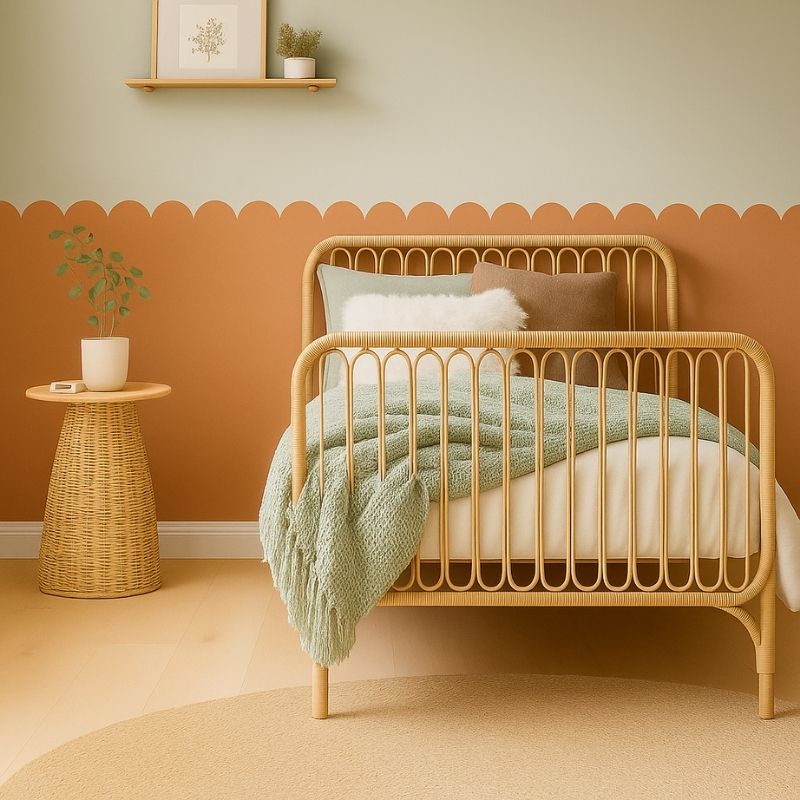
How to apply nursery wall decals without mistakes
Application errors account for the majority of negative reviews in the decal category. Bubbles, edge lifting, misalignment — all are preventable with a disciplined installation process.
Step-by-step application guide:
- Clean the wall surface. Wipe with a lint-free cloth dampened with isopropyl alcohol (70% solution). Allow to dry completely — minimum 15 minutes. Any grease, dust, or moisture will reduce adhesion by up to 60%.
- Condition the room temperature. Adhesives perform best between 18°C and 26°C. Below 15°C, water-based acrylics lose tack permanently.
- Plan placement before peeling. Use painter’s tape to mock up the arrangement on the wall. Take a photo with your phone. Adjust before committing.
- Peel slowly at a 45° angle. Peeling straight back causes the decal to curl and fold. A 45° angle maintains tension and keeps the film flat.
- Smooth from centre outward. Use a credit card or soft squeegee, not your fingernail, to eliminate bubbles progressively from the middle of the decal to the edges.
- Do not press the edges down last. Edge adhesion is self-completing as the centre is smoothed — forcing the edges down first traps air.
How to remove nursery wall decals cleanly
When removal time comes, heat is the key variable. A standard hair dryer set to medium heat, held 10–15 cm from the surface, softens the adhesive in approximately 20 seconds per 30 cm² section. Peel slowly while the adhesive is warm. On freshly painted walls (painted within 30 days), test a small corner first — some latex paint formulations remain partially soluble for several weeks.
Nursery wall art stickers for girls: popular themes and placement ideas
Girl nursery wall art stickers consistently outperform average search volumes in the broader nursery decal category. The highest-conversion searches combine aesthetic specificity with safety language: “non toxic floral nursery decals for girls” or “peel and stick rainbow wall art girl nursery.”
Placement strategy matters as much as design selection. Research in developmental vision science shows that newborns up to 3 months see most clearly at a focal distance of 20–30 cm, meaning ceiling and high-wall placements are largely wasted on the youngest occupants. Optimal placement for infant visual engagement is 40–80 cm from the floor — at eye level for a parent holding a baby or for a child lying in a cot.
For a cohesive girl nursery layout using dosjunior decals, consider:
- Focal wall behind the crib: Large single-element decal (floral arch, rainbow, or botanical branch) centred at 120–140 cm from the floor.
- Side walls: Scatter smaller elements — individual flowers, stars, birds — at varying heights between 60 cm and 160 cm for visual movement.
- Above the changing station: Alphabet or number decals that become interactive as the child develops language awareness at 12–18 months.
The principle of intentional asymmetry — more design density on one wall, breathing space on the others — prevents visual overload, which paediatric occupational therapists associate with overstimulation in sleep environments.
Frequently asked questions
Are nursery wall art stickers safe for newborns?
Yes, provided they are manufactured with water-based adhesives and EN71-certified inks. Low-quality PVC decals can off-gas VOCs above WHO-recommended indoor thresholds for up to 7 days after application. Always verify the certification on the product listing and ventilate the room for 24 hours before placing the baby inside.
How long do peel and stick nursery wall decals last on the wall?
High-quality peel and stick nursery wall decals adhere reliably for 3–5 years on smooth, properly primed painted surfaces. Adhesion degrades in high-humidity environments (above 70% RH) or on textured walls. Repositioning more than 2–3 times progressively reduces tack due to lint and dust accumulation on the adhesive layer.
Do nursery wall decals damage paint when removed?
No, when applied to fully cured paint (dried for at least 28 days) and removed correctly. Use a hair dryer at medium heat to warm the adhesive before peeling at a 45° angle. Damage most commonly occurs on paint applied within 30 days of decal installation or on flat/matte paint sheens, which bond more aggressively with pressure-sensitive adhesives.
Are nursery wall stickers worth it compared to other nursery wall decor options?
For most parents, yes. Peel and stick nursery wall art stickers cost between $15–$60 per set versus $200–$800 for a professionally painted mural, install in under 30 minutes, cause no wall damage, and update easily as the child grows. The only scenario where they underperform is on heavily textured walls, where adhesion can be unreliable.
Sonuç
Nursery wall art stickers occupy a unique position in children’s room decor: they are simultaneously the safest, most affordable, and most flexible option available to parents today. The key is selecting products backed by third-party safety certifications — EN71 for ink chemistry, REACH compliance for broader chemical restriction — rather than relying on brand claims alone. Style, placement strategy, and proper application technique turn a simple decal set into a cohesive, developmentally appropriate environment that grows with a child from newborn through toddler years.
Browse the dosjunior nursery wall decal collection — filter by theme, safety certification, or room style to find the exact set your nursery needs.