

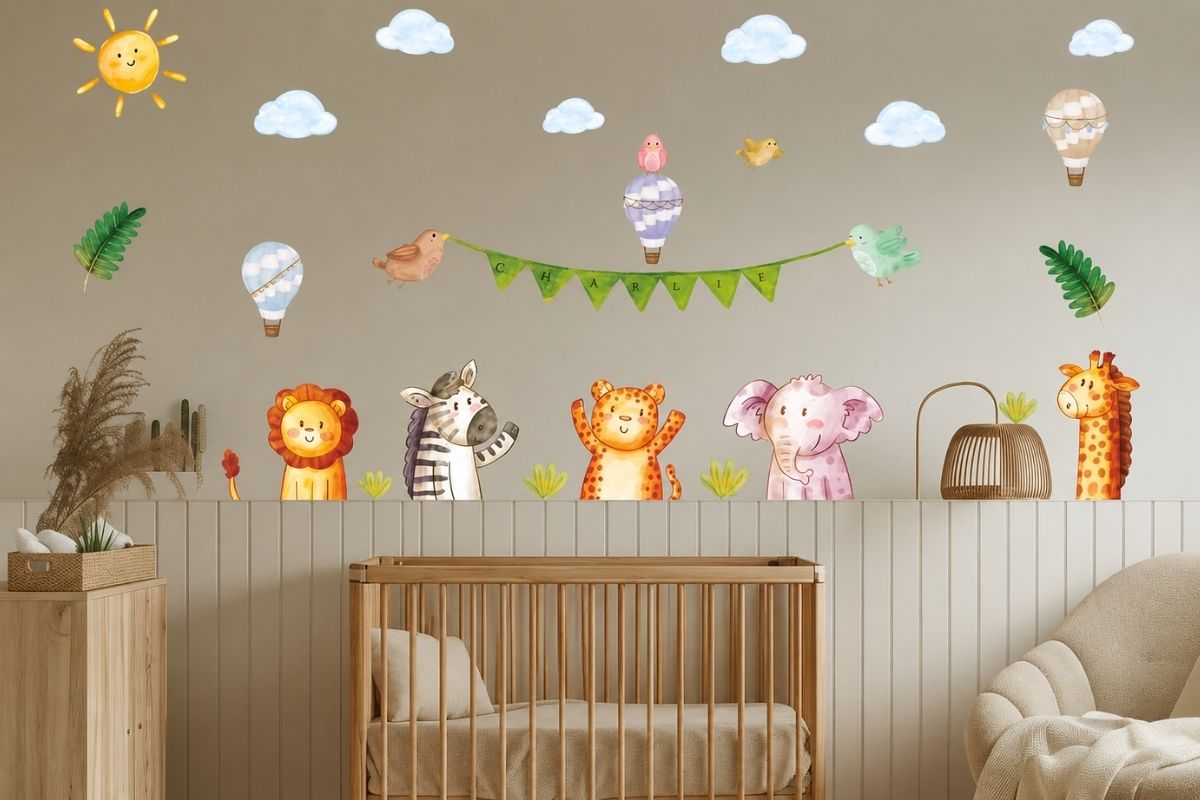
Animal wall decals for nursery are one of the fastest-growing baby room décor solutions on the market — and the logic is simple: they apply in under an hour, cost a fraction of a professional mural, and peel away cleanly when it is time for a change. Whether the vision is a dense jungle canopy, a peaceful farm meadow, a safari savanna, or a full zoo expedition across a feature wall, every design decision comes down to theme, material, surface compatibility, and installation technique. This guide walks through each of those decisions with the specificity parents actually need before buying.
What are animal wall decals for nursery?
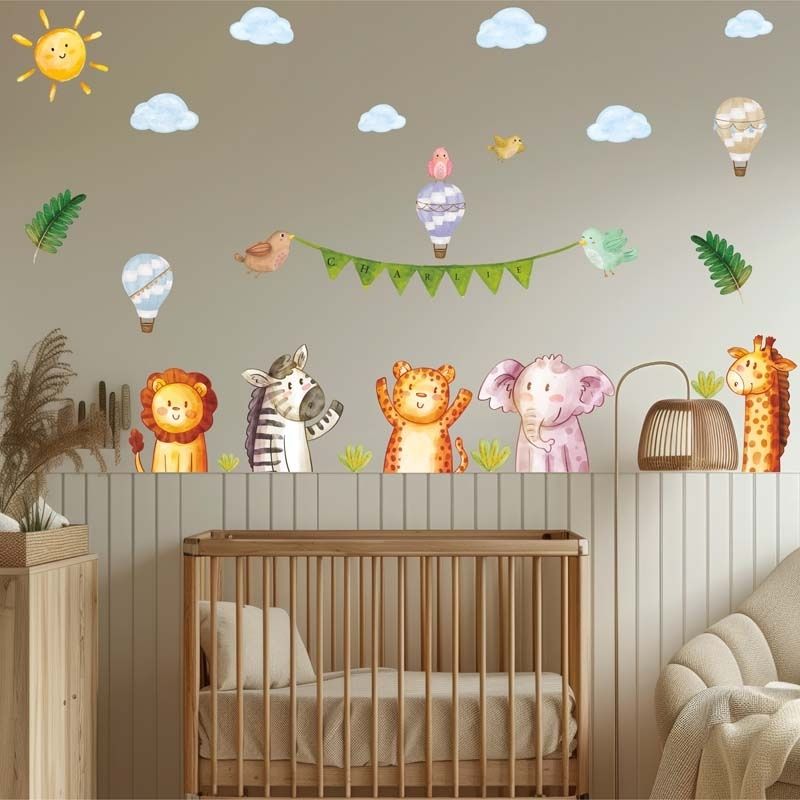
Animal wall decals for nursery are pre-cut, pressure-sensitive graphics — printed on vinyl or woven fabric — that bond to smooth wall surfaces without nails, wallpaper paste, or any heat tools. Unlike hand-painted murals that require professional labor and multi-day drying periods, a quality decal set transforms a blank wall in 15 to 45 minutes and reverses completely when removed correctly.
The adhesive system works as follows: each piece ships sandwiched between a release backing and a protective transfer film. The installer peels the backing away, positions the graphic against the wall, and presses firmly from the center outward to eliminate air. On a correctly prepared surface — clean, dry, free of dust, oils, and insufficiently cured paint — the decal bonds within 24 to 48 hours and remains dimensionally stable for years without edge lifting or color loss.
Core product specifications:
| Property | Standard Detail |
|---|---|
| Material | Vinyl (PVC-free options) or woven fabric |
| Adhesive type | Repositionable or permanent pressure-sensitive |
| Removal | Clean peel, zero residue on cured latex paint |
| Application time | 15–45 minutes for a full wall set |
| Stable lifespan | 2–5 years under normal indoor conditions |
| Ideal install temp | 18°C–25°C at the wall surface |
The most important product distinction is between repositionable and permanent adhesive formats. Repositionable decals use lower-tack adhesive that allows realignment during installation and clean removal years later without damaging paint. Permanent-adhesive versions bond more aggressively — the correct choice for high-humidity nurseries where temperature fluctuation makes edge-lifting a genuine risk. DosJunior labels this distinction clearly on every product listing so parents can make the right call based on their specific room conditions rather than guessing.
Jungle, farm, safari, or zoo: which nursery theme works best for your room?
Theme selection is the single most consequential design decision in a nursery project because it sets the color palette, furniture finish, textile direction, and lighting temperature simultaneously. Each of the four dominant animal nursery themes carries distinct visual logic, compositional trade-offs, and longevity characteristics.
Jungle animal wall decals for nursery
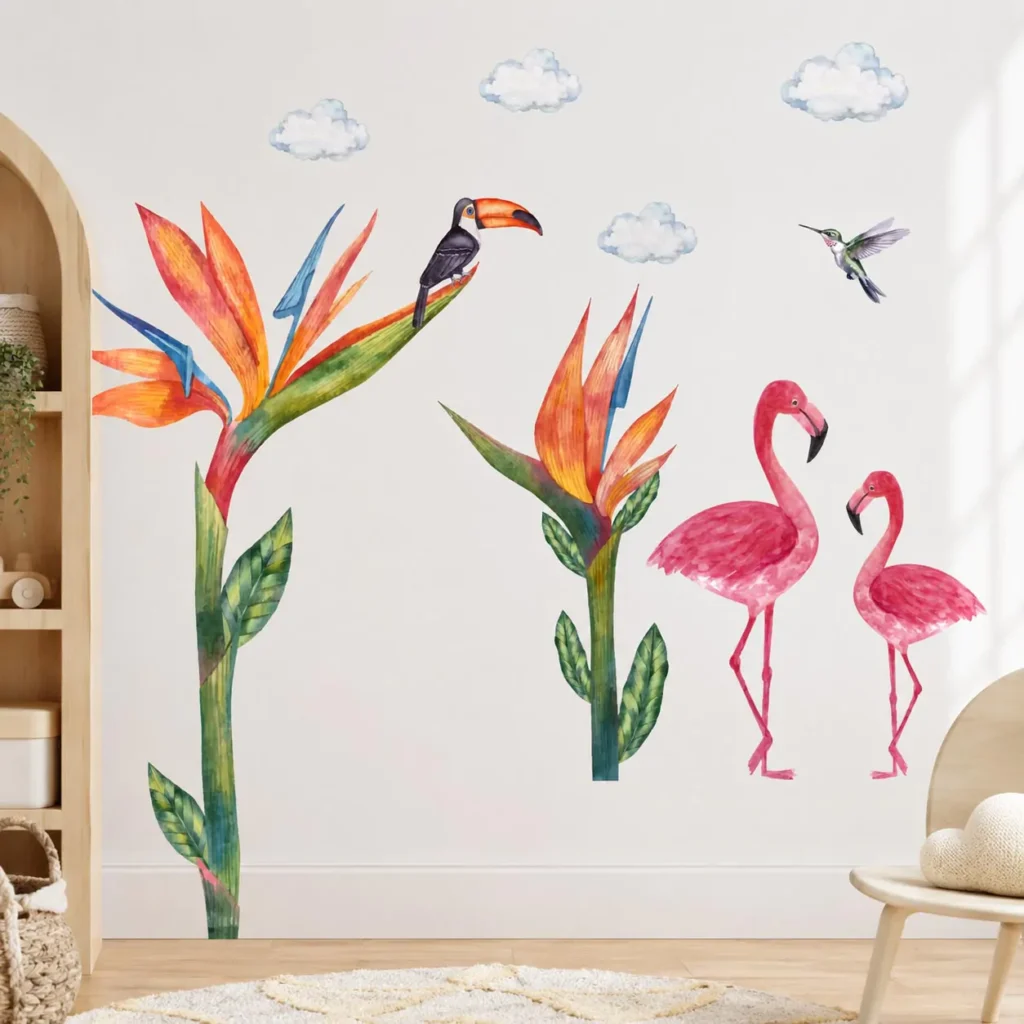
Jungle themes lead search volume in the animal nursery décor category by a wide margin — a pattern visible directly in Google’s related search data, where jungle-specific queries appear before every other sub-theme. The visual anchor of a jungle set is typically a large-format tropical composition: toucans, monkeys, sloths, tigers, and oversized palm or banana foliage layered across the wall in overlapping planes. The palette runs deep — emerald, sage, warm ochre, and terracotta — which means the decal provides all the color contrast independently. Jungle animal wall decals for nursery pair best with neutral wall colors, specifically warm white, greige, or pale sage, where the graphic carries the room without visual competition from the painted background.
Standard jungle sets contain 30 to 60 individual pieces and cover approximately 1.2 m² to 2.5 m² of configured wall space. For rooms with a dedicated accent wall, a focused large-format jungle set creates an immersive focal point that reads immediately from the doorway. For larger nurseries exceeding 14 m², corner-wrapping compositions that span two adjacent walls deliver significantly more environmental impact than a single flat panel. DosJunior’s jungle collections are available in both accent-wall and corner-wrap configurations, with piece counts scaled to room size rather than using a single standard format for all applications.
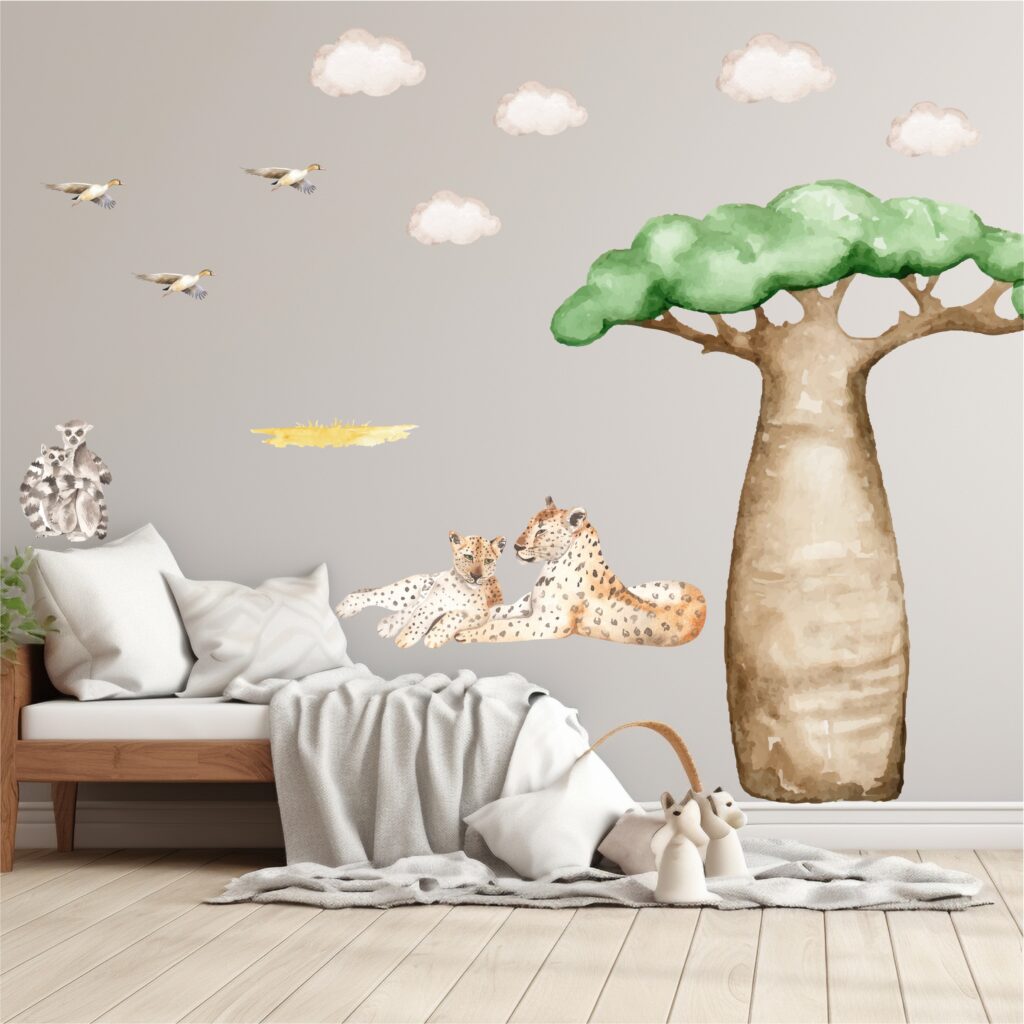
Farm animal wall decals for nursery
Farm themes operate in a softer, more pastoral aesthetic register. Cows, sheep, pigs, roosters, red barn silhouettes, wooden fences, and rolling meadow backgrounds create warmth that pairs naturally with raw wood furniture, linen textiles, and muted gingham pattern accents. The palette skews toward cream, dusty rose, sky blue, and straw yellow — colors that read as friendly at infant stage and remain appropriate through age five without appearing babyish.
Interior designers working specifically in nursery and children’s room projects consistently note that farm animal wall decals for nursery transition more gracefully into toddler room configurations than jungle or safari alternatives. The imagery is compositionally quieter, individual motif scale is typically smaller, and the overall room reads as nurturing rather than dramatic. For parents who want a nursery that remains functional through age 5 without a full redesign, farm themes represent the most durable long-term investment in the category.
Safari animal wall decals
Safari themes — giraffes, elephants, zebras, lions, and acacia tree silhouettes — occupy a confident visual middle ground. The palette is warmer and more muted than jungle: burnt sienna, dusty gold, warm taupe, and terracotta tones that work equally well in gender-neutral, traditionally feminine, and traditionally masculine nursery schemes. That neutrality gives safari sets broader compatibility with existing furniture finishes and wall colors than the high-contrast jungle palette.
Individual motif scale in safari collections tends to run significantly larger than in farm or zoo sets. A single giraffe graphic at 90 to 120 cm standing height creates an immediate, anchor focal point that smaller motif sets cannot replicate. This large-format quality makes safari animal decals particularly effective in rooms with ceiling heights above 2.7 m, where smaller-scale compositions look visually sparse against the available wall real estate.
Zoo animal wall decals for nursery
Zoo animal wall decals for nursery follow similar visual logic to safari collections but introduce a substantially wider species roster: penguins, polar bears, flamingos, hippos, crocodiles, and parrots appear alongside the savanna staples. That species variety appeals strongly to parents with an educational angle in mind — as the child moves from infant to toddler to preschool stage, a zoo-themed wall functions as a daily interactive reference for animal names, sounds, and habitats.
Zoo collections also scale compositionally across larger nurseries more effectively than single-biome themes. The species variety allows thematic zoning across multiple walls — a tropical corner, an arctic panel, a safari section — without visual repetition. For rooms exceeding 18 m² where a single accent-wall treatment would look isolated, zoo collections offer the compositional flexibility to fill the space as a complete environment.
Theme comparison at a glance:
| Theme | Best for | Core palette | Longevity into toddler years |
|---|---|---|---|
| Jungle | Maximum visual impact | Deep greens, ochre | Moderate |
| Farm | Long-term versatility | Pastels, cream, sky blue | Excellent |
| Safari | Gender-neutral rooms, high ceilings | Earth tones, dusty gold | Good |
| Zoo | Educational rooms, large spaces | Mixed, species-driven | Very good |
Are nursery wall decals safe for newborns, and what certifications actually matter?
Safety is the non-negotiable filter in any nursery product category, and animal wall decals are no exception. Two primary risk vectors apply: chemical off-gassing from adhesives and printing inks during and after installation, and physical durability once the child reaches the age at which they begin pulling at surfaces within arm’s reach.
Chemical safety certifications to look for
The following certifications provide independently verified safety assurance rather than manufacturer self-reporting:
- GREENGUARD Gold — certifies that VOC (volatile organic compound) emissions fall below the thresholds established specifically for children’s indoor environments; this is the most directly relevant certification for any product applied to nursery walls
- ASTM F963 — the US consumer product safety standard; voluntary compliance by decal manufacturers signals material safety scrutiny well beyond baseline regulatory requirements
- EN 71-3 — the European standard governing migration of chemical elements from children’s materials; increasingly adopted by quality manufacturers globally and considered rigorous by independent testing laboratories
- Oeko-Tex Standard 100 — specifically relevant for fabric-based decals; confirms the textile substrate is free of harmful substances tested at every stage of the production chain
Solvent-based printing inks present the highest off-gassing risk, concentrated in the 48–72 hours immediately following application. Water-based UV-cured inks — now standard practice among quality-positioned manufacturers — produce negligible VOC output after installation. DosJunior nursery decals are produced with water-based inks and include explicit ventilation guidance in every shipment, reflecting a product development approach grounded in occupant safety rather than minimum compliance.
Practical protocol regardless of certification level: apply decals a minimum of 72 hours before the infant occupies the room, with windows open during application and for at least 24 hours afterward. This single precaution eliminates the overwhelming majority of air-quality concern independent of ink chemistry or adhesive formulation.
Physical durability as the child grows
Once the child reaches 18 to 24 months and begins actively exploring wall surfaces, edge-lifting from small hands becomes a practical concern for decals positioned below 90 cm from the floor. The most effective mitigation is compositional: position all large-format motifs with their lowest visible edge at 100 cm or above, and use the lower wall zone for painted accent color or a non-adhesive textile panel that does not present a peelable edge to curious hands.
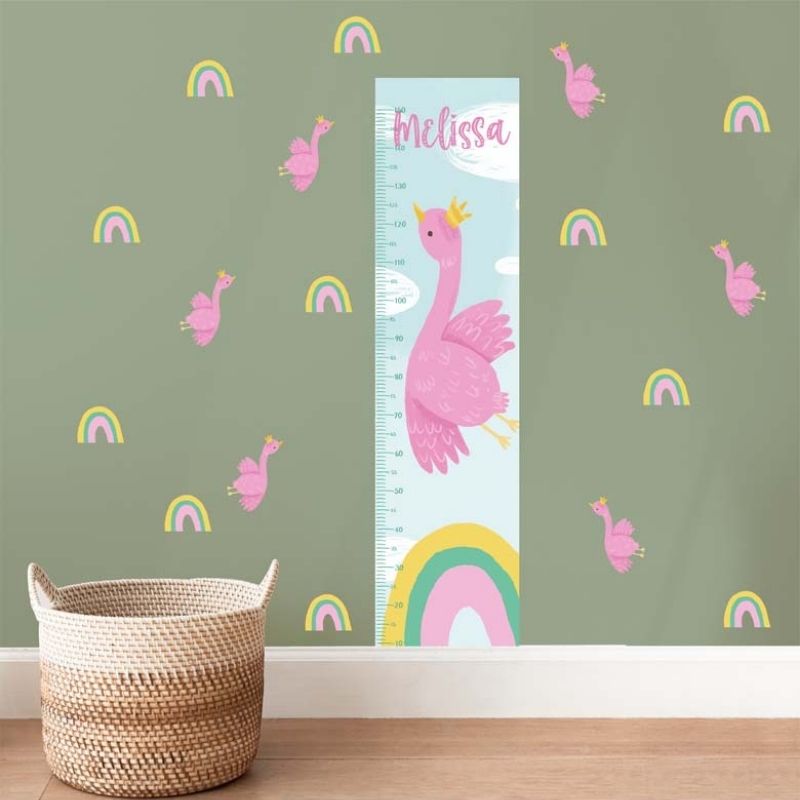
How to apply animal wall decals for nursery correctly the first time
Incorrect application accounts for the overwhelming majority of nursery decal complaints — lifted edges, air bubbles, misaligned graphics — and almost none of those failures are product quality issues. They are surface preparation failures. A structured installation process takes under one hour and prevents every common problem from occurring in the first place.
Surface preparation — the step most buyers skip
Wipe the target wall with a clean, slightly damp microfiber cloth to remove dust, skin oils, and residue from previous cleaning products. Allow the surface to dry completely — minimum two hours in a ventilated room, and longer in climates where ambient humidity regularly exceeds 70%. Do not use any cleaning product containing silicone, wax, petroleum distillates, or bleach: all of these leave invisible surface films that degrade adhesive contact without any visible indicator that a problem has been created.
The most important timing rule in the entire installation process: freshly painted walls must cure for a minimum of 30 days before any decal is applied. Latex paint appears surface-dry within hours but continues off-gassing plasticizers and hardening its binder network for several weeks after application. Decals applied to paint cured fewer than 30 days bond to the soft paint layer rather than the primer below — and when the decal is eventually removed, the paint layer comes with it, producing damage that requires patching and repainting.
Step-by-step installation process
- Place the decal face-up on a flat, clean surface. Use a credit card or plastic squeegee to pre-press the graphic firmly and evenly against the transfer film. This step ensures the graphic separates cleanly from the release backing rather than lifting with it.
- For sets containing multiple motifs on a single sheet, cut the sheet into individual pieces before beginning wall installation. Sections wider than 30 cm become difficult to align and press accurately in a single movement.
- Peel the release backing at a 45° angle while keeping the transfer film taut. If the graphic lifts with the backing instead of remaining on the transfer film, lay the piece flat and re-press with the squeegee before attempting again.
- Hold the decal against the wall in the intended position before making full contact. Repositionable adhesive allows two to three adjustments before tack begins to diminish.
- Press from the center outward using firm, overlapping strokes with the flat of the hand or a squeegee. Work in a consistent direction — do not press randomly or air pockets will migrate rather than exit at the edges.
- Wait 60 seconds after full contact, then peel the transfer film back at a 180° angle — pulling back against itself along the wall surface, not pulling upward away from the wall. A slow, controlled pull produces cleaner graphic transfer than a fast one.
- Smooth any remaining air pockets immediately with a fingertip. Once the adhesive begins to cure after 24 hours, air pockets cannot be pressed out without re-lifting the decal.
Room temperature during installation should remain between 18°C and 25°C. Walls below 10°C dramatically reduce initial adhesive tack and produce false installation failures; walls above 30°C cause the adhesive to set before accurate alignment is achievable.
How long do nursery wall decals last and can they be removed without wall damage?
Lifespan under real-world nursery conditions varies by adhesive formulation, surface paint finish, and ambient environment. On properly cured flat or eggshell latex paint, quality repositionable decals maintain clean adhesion for 2 to 3 years. Permanent-adhesive versions on satin or semi-gloss surfaces regularly exceed 5 years without edge lifting or measurable color fade under normal indoor lighting. Direct sunlight is the primary accelerant of color degradation — UV-stabilized inks extend color life significantly on south-facing nursery walls receiving more than 4 hours of direct light daily.
Wall surface finish is the most important variable in predicting removal outcome. Satin and semi-gloss latex paints have higher binder density and release pressure-sensitive adhesive cleanly. Flat and matte latex finishes carry moderately higher risk of minor surface disturbance. Chalky-finish paints — including chalk paint and limewash formulations — are incompatible with standard pressure-sensitive adhesive decals; the finish layer will almost always separate from the substrate on removal regardless of how carefully the process is performed.
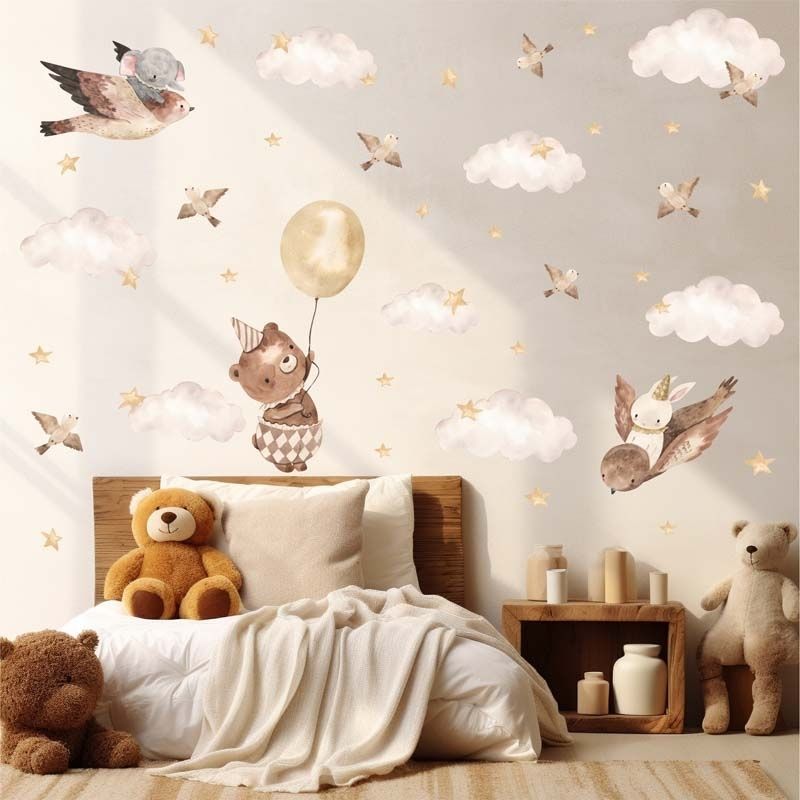
Correct removal process:
- Set a hair dryer to low heat and warm the decal surface to approximately 40–50°C — roughly 20 to 30 seconds per 30 cm section. This softens the adhesive interface without overheating the paint below.
- Lift one corner using a fingernail or flat plastic card. Never use a metal scraper or utility blade against a painted wall surface.
- Peel at a very low angle — 15 to 30° from the wall — moving steadily rather than in bursts. If resistance increases at any point, stop and re-warm before continuing. Pulling through resistance is the primary cause of paint surface damage.
- If adhesive residue remains after removal, apply 70% isopropyl alcohol to a soft cotton cloth and rub gently in a circular motion. Residue dissolves within seconds. Avoid acetone or petroleum-based solvents entirely on painted surfaces.
Walls painted fewer than 6 months before decal removal carry elevated disturbance risk — not because of the decal adhesive strength, but because the paint binder network continues hardening and compacting for up to 6 months after application, and removal before that process completes interrupts the bond between paint layers.
Frequently Asked Questions
What is the best animal theme for a gender-neutral nursery?
Jungle and woodland animal themes perform best in gender-neutral nursery settings. Both palettes — deep greens, warm browns, and cream tones — sit outside conventional gender color associations and read as universally friendly. Safari themes in muted earth tones are a strong second option. Farm themes can work in gender-neutral contexts but trend slightly gendered depending on the specific color palette of the individual set.
Are removable wall decals for nursery safe to use on textured walls?
No. Textured wall surfaces — orange peel, skip trowel, knockdown, and sand finishes — create uneven adhesive contact that results in lifted edges within days to weeks of installation. A smooth surface is required for reliable adhesion. The two practical workarounds are skim coating the target wall section before installation, or using a framed fabric panel as a non-adhesive alternative for rooms where wall texture cannot be modified.
How much do animal wall decals for nursery cost compared to a professionally painted mural?
A quality nursery decal set ranges from $18 to $85 USD depending on piece count, material type, and print resolution. A professionally painted nursery mural typically starts at $300 to $600 USD for a single accent wall and rises sharply with compositional complexity. Decals deliver approximately 85 to 95% of the equivalent visual impact at 10 to 20% of the cost, with the added practical advantage of damage-free removal when the child’s preferences evolve.
Can animal wall decals be applied to nursery furniture as well as walls?
Yes. Vinyl decals adhere reliably to any smooth, non-porous surface — painted wood furniture, glass panels, and sealed MDF cabinet fronts are all fully compatible substrates. Fabric-based decals do not bond reliably to hard furniture surfaces and should be used on walls only. Surface preparation rules apply identically to furniture: the surface must be clean, completely dry, free of oils, and finished with a fully cured topcoat before any decal is applied.
Sonuç
Animal wall decals for nursery offer a combination of visual impact, installation simplicity, certified material safety, and cost efficiency that no other decorating approach delivers at a comparable price point. The selection framework is clear once room dimensions, wall finish, and the infant’s move-in date are accounted for: jungle sets for maximum visual drama on neutral accent walls; farm and woodland themes for rooms designed to carry through toddlerhood without redesign; safari collections for gender-neutral schemes in rooms with high ceilings; zoo sets for larger spaces where thematic variety is needed to fill the environment cohesively. Animal wall decals for nursery are not a compromise solution — they are the practical first choice for parents who want a finished, well-designed room without permanent commitment.