

Baby false starts happen when a baby falls asleep at bedtime but wakes up crying within 20 to 45 minutes — too soon to have completed a full sleep cycle. It is one of the most common and exhausting patterns parents face in the first year. Understanding the biology behind false starts makes them far less mysterious and, more importantly, fixable. This article covers the exact causes, age-specific triggers, and practical steps to stop them.
What are baby false starts?
Baby false starts refer to a specific night-waking pattern where an infant falls asleep at the normal bedtime hour and then wakes fully — usually crying or fussing — within the first 20 to 45 minutes. Unlike brief nighttime stirrings where a baby resettles independently, a false start results in a wide-awake, often distressed baby who needs active help returning to sleep.
The term is widely used among pediatric sleep consultants and parent communities, though it does not appear as a clinical diagnosis in medical literature. What makes false starts distinct from regular nighttime wake-ups is their timing: they occur before the baby has transitioned out of their first sleep cycle, typically between the 30- and 45-minute mark.
Key characteristics that define a false start:
- The baby falls asleep normally at bedtime without unusual difficulty
- Waking occurs within 20 to 45 minutes of initial sleep onset
- The baby is fully awake, not simply stirring or fussing lightly
- The baby cannot resettle without parental intervention
- The pattern repeats on consecutive nights rather than occurring once
False starts are most common between 2 and 6 months of age, though they can persist or reappear during developmental leaps at any point in the first two years.
Why do baby false starts happen? The sleep science explained
Baby sleep cycles are significantly shorter than adult cycles. Where adults cycle through sleep stages every 90 to 120 minutes, infant sleep cycles last approximately 30 to 50 minutes. At the end of each cycle, the brain produces a partial arousal — a brief, light waking moment that most adults pass through without noticing. Babies who have not yet developed the skill of independent sleep cycle linking will fully wake during this transition instead of drifting into the next cycle.
During this partial arousal, the baby’s brain essentially checks whether the conditions present at sleep onset — being held, rocked, fed, or in a particular environment — are still present. If they are not, the brain registers a mismatch and triggers a full waking response. This mechanism is sometimes called the sleep association disconnect.
There is also a hormonal component. When a baby is overtired at bedtime, the body releases cortisol and adrenaline as a stress response. These stress hormones actively work against melatonin, the primary sleep hormone, creating a paradox: the baby falls asleep quickly due to exhaustion but cannot maintain sleep as cortisol continues circulating. Research in pediatric sleep medicine consistently identifies overtiredness as one of the leading physiological drivers of fragmented early-night sleep.
Understanding these two mechanisms — the sleep cycle transition and the cortisol response — explains why so many of the practical fixes for false starts work. They address either the sleep association mismatch, the stress hormone cycle, or both simultaneously.
What age are baby false starts most common?
False starts do not affect all babies equally at all ages. The developmental stage of the baby’s nervous system plays a significant role in both the likelihood and intensity of false starts.
| Age range | Primary cause | Wake window before bed |
|---|---|---|
| 0–8 weeks | Immature sleep architecture | 45–60 minutes |
| 2–4 months | 4-month sleep regression onset | 75–90 minutes |
| 4–6 months | Sleep association reliance | 1.5–2 hours |
| 6–9 months | Overtiredness or undertiredness | 2.5–3 hours |
| 9–18 months | Developmental leaps, separation anxiety | 3–4 hours |
The 2-to-4-month window is particularly prone to false starts because this period marks the transition from newborn sleep architecture — which is approximately 50% active (REM) sleep — to a more adult-like pattern with distinct light and deep sleep stages. This neurological shift, commonly called the 4-month sleep regression, permanently changes how babies cycle through sleep and is the single most common trigger parents report for the onset of false starts.
Between 6 and 9 months, the cause shifts. False starts at this age are more frequently linked to undertiredness — where the last nap ended too recently and the baby has not built sufficient sleep pressure — or to overtiredness, where the wake window before bed stretched too long. Both extremes produce the same surface symptom: a baby who wakes 30 to 45 minutes after bedtime.
What triggers false starts? The 5 most common causes
Identifying the specific trigger behind a baby’s false starts is the most important step toward fixing them. The five causes below account for the vast majority of cases seen by pediatric sleep consultants.
1. Overtiredness at bedtime
When a baby stays awake beyond their optimal wake window, cortisol levels rise sharply. The baby may appear wired, hyperactive, or difficult to settle — counterintuitive signals that parents often misread as undertiredness. Moving bedtime 20 to 30 minutes earlier is frequently the single most effective intervention for overtiredness-driven false starts.
2. Undertiredness and insufficient sleep pressure
A baby who napped too recently, or whose last nap ran too long, may not have accumulated enough sleep pressure to maintain consolidated nighttime sleep. In this case, the baby treats bedtime as a short nap rather than the start of a long overnight sleep. Shortening the final nap of the day or extending the last wake window slightly — by 15 to 20 minutes at a time — can build the sleep pressure needed.
3. Sleep association disconnect
If a baby always falls asleep in one context — being fed, rocked, or held — and wakes to find themselves in a still, quiet crib, the environmental mismatch triggers a full waking. This is not a behavioral problem; it is a neurological one. The brain is doing exactly what it is designed to do: raise an alert when the environment has changed unexpectedly. Gradually teaching the baby to fall asleep in the crib, drowsy but awake, addresses the root cause rather than the symptom.
4. Environmental mismatches
Room temperature, light levels, and sound can all contribute to false starts. Pediatric sleep guidelines recommend a room temperature between 18°C and 20°C (65°F to 68°F) for infant sleep. Light is particularly significant: even low-level ambient light can suppress melatonin production in infants, whose circadian systems are still developing. Blackout curtains that eliminate light completely — not just dim it — have been reported by many parents to produce immediate improvements. Consistent white noise at approximately 65 decibels helps mask environmental sound changes that might otherwise trigger a partial arousal into a full waking.
5. Hunger
A baby who is not adequately fed before bed may wake as hunger signals intensify during the light sleep phase at the end of the first cycle. A dream feed — offered between 10 PM and 11 PM while the baby is still mostly asleep — can preemptively address hunger without fully waking the baby and has been shown in parent-reported sleep studies to extend the first overnight stretch for some infants, though individual responses vary.
How to fix baby false starts: a step-by-step action plan
Fixing false starts requires identifying which of the five triggers above is dominant and addressing it systematically. The following sequence works for most families within 7 to 14 days when applied consistently.
Step 1: Audit the wake window
Check whether the time between the end of the last nap and bedtime is appropriate for the baby’s age using the table above. If the gap is too short or too long by more than 30 minutes, adjust by 15-minute increments every 2 to 3 days rather than making a sudden large change.
Step 2: Optimize the sleep environment
Before adjusting any routine elements, ensure the physical sleep space is working in the baby’s favor. The room should be:
- Completely dark — no nightlights, no light seeping under doors
- Set between 18°C–20°C (65°F–68°F)
- Running consistent white noise at 65–70 decibels
- Free from overstimulating visual elements directly in the baby’s eyeline
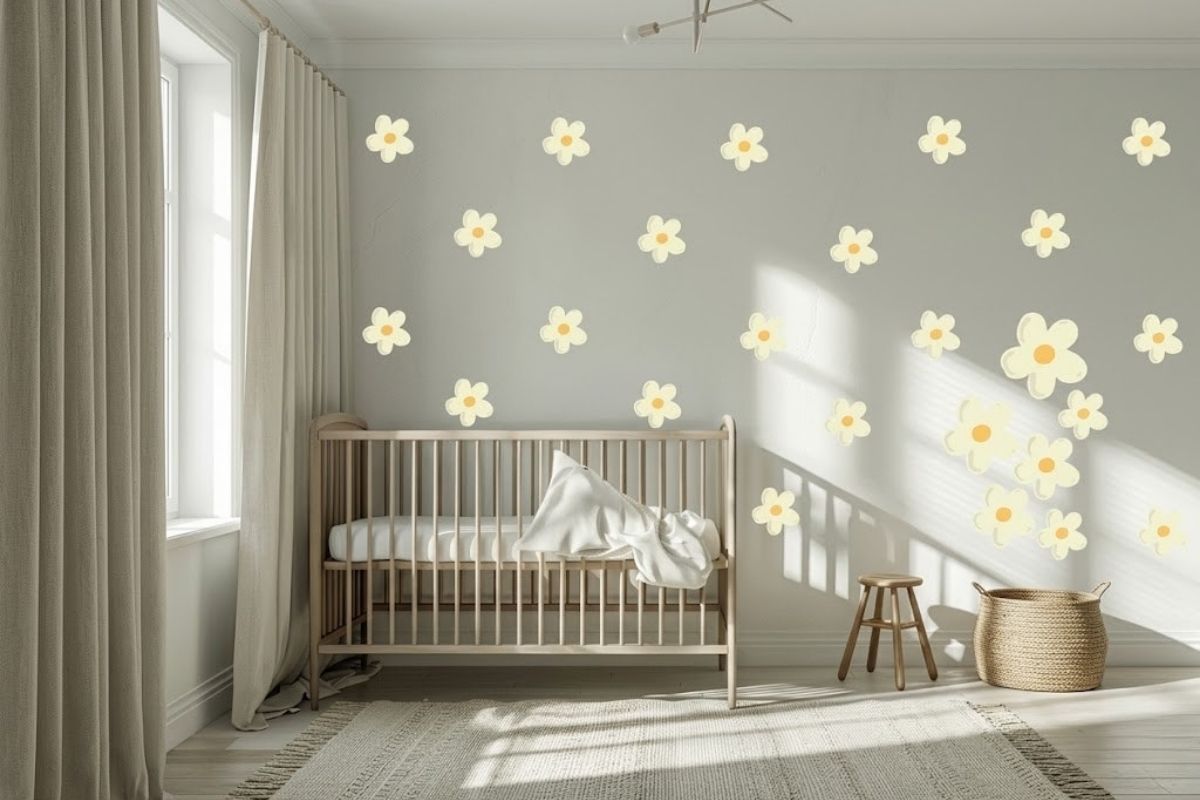
A calm, visually consistent sleep space does more than support sleep onset — it reduces the environmental mismatch the baby’s brain detects during the partial arousal at the end of the first sleep cycle. This is where the nursery environment becomes genuinely functional rather than merely decorative. Thoughtfully designed wall art, soft textiles, and a clutter-free layout contribute to a low-stimulation atmosphere that supports deeper, longer sleep. The Dos Junior wall hangings and textile collection is designed with exactly this in mind — pieces that are visually engaging during waking hours but calm and unobtrusive in a darkened sleep space.
Step 3: Shift the bedtime routine
A consistent 20-to-30-minute wind-down routine signals the nervous system that sleep is approaching. The routine should move from higher stimulation to lower stimulation, ending with the final feed in a calm, dimly lit environment. Keeping the routine identical each night — same order, same duration, same environment — accelerates the association between the routine and sleep onset.
Step 4: Work on independent sleep onset
If sleep associations are the primary driver, the next step is gradually reducing the level of assistance the baby receives at sleep onset. Placing the baby in the crib drowsy but still awake — even briefly — begins building the neural pathway for independent sleep cycle linking. This is not an overnight change. Most families see meaningful improvement over 10 to 14 nights of consistent practice.
Step 5: Consider a dream feed
For babies under 6 months, introducing a dream feed between 10 PM and 11 PM can eliminate hunger as a contributing factor without disrupting the sleep environment or routine. Not all babies respond to dream feeds, and some are disturbed rather than helped by them — trial for 4 to 5 nights before drawing conclusions.
When do false starts stop on their own?
False starts are a developmental phase, not a permanent condition. For most babies, they resolve naturally as the nervous system matures and sleep cycle linking improves. The 4-month sleep regression — which drives many of the most intense false start episodes — typically stabilizes within 4 to 6 weeks as the baby adapts to the new sleep architecture.
Between 6 and 9 months, most babies who have learned to fall asleep independently show a significant reduction in false starts. By 12 months, false starts are relatively uncommon in babies who have a consistent bedtime routine, an appropriate nap schedule, and a sleep environment that supports continuous sleep.
Parents should be aware that false starts can temporarily reappear during developmental leaps, illness, travel, or any disruption to the routine. These are typically short-lived and resolve within a few days once the routine is re-established.
If false starts persist beyond 6 months despite consistent implementation of the steps above, or if they are accompanied by unusual breathing patterns, frequent arching of the back, or signs of persistent discomfort, consulting a pediatrician is the appropriate next step to rule out contributing factors such as reflux or sleep-disordered breathing.
Frequently asked questions
Why does my baby wake up exactly 30 minutes after falling asleep every night?
A baby waking consistently at 30 minutes is completing one sleep cycle and failing to transition into the next. The 30-minute mark aligns with the end of the first infant sleep cycle. The cause is almost always a sleep association mismatch, overtiredness, or an environmental trigger. Auditing the wake window and sleep environment resolves this in most cases within 1 to 2 weeks.
Are false starts the same as the 45-minute intruder?
No. The 45-minute intruder refers specifically to short naps during the day, where a baby wakes after one sleep cycle and cannot resettle. False starts refer exclusively to night sleep and occur within 20 to 45 minutes of bedtime — before the baby has entered the deeper consolidation phase of overnight sleep. Both share the same root cause — incomplete sleep cycle linking — but the timing, context, and fixes differ.
Do blackout curtains actually help with baby false starts?
Yes, for many families. Light is one of the most potent suppressors of melatonin in infants. Even low ambient light — from streetlights, hallway gaps, or nightlights — can interfere with the melatonin surge that supports the transition between sleep cycles. Full blackout curtains that eliminate all visible light are consistently reported as one of the most impactful single changes parents make to reduce false starts and early morning wakings.
Should I let my baby cry during a false start or go in immediately?
There is no single correct answer, and the right approach depends on the baby’s age, the suspected cause, and the family’s approach to sleep. For babies under 4 months, immediate response is generally recommended as self-settling capacity is neurologically limited. For older babies, a brief pause of 2 to 5 minutes before responding allows the baby an opportunity to attempt self-settling. If the baby escalates quickly to full distress, responding promptly remains appropriate regardless of age.
Conclusion
Baby false starts are exhausting but almost always solvable. The key is identifying whether the root cause is overtiredness, undertiredness, a sleep association mismatch, an environmental trigger, or hunger — then addressing that specific cause systematically rather than trying every fix at once. Most families see meaningful improvement within 7 to 14 days of consistent changes. The sleep environment, in particular, is one of the most overlooked and most effective levers available: a dark, quiet, thermally comfortable nursery reduces the sensory mismatches that turn a normal partial arousal into a full false start. Browse the Dos Junior nursery collection for wall hangings, textiles, and decor designed to create exactly that kind of calm, consistent sleep space.