

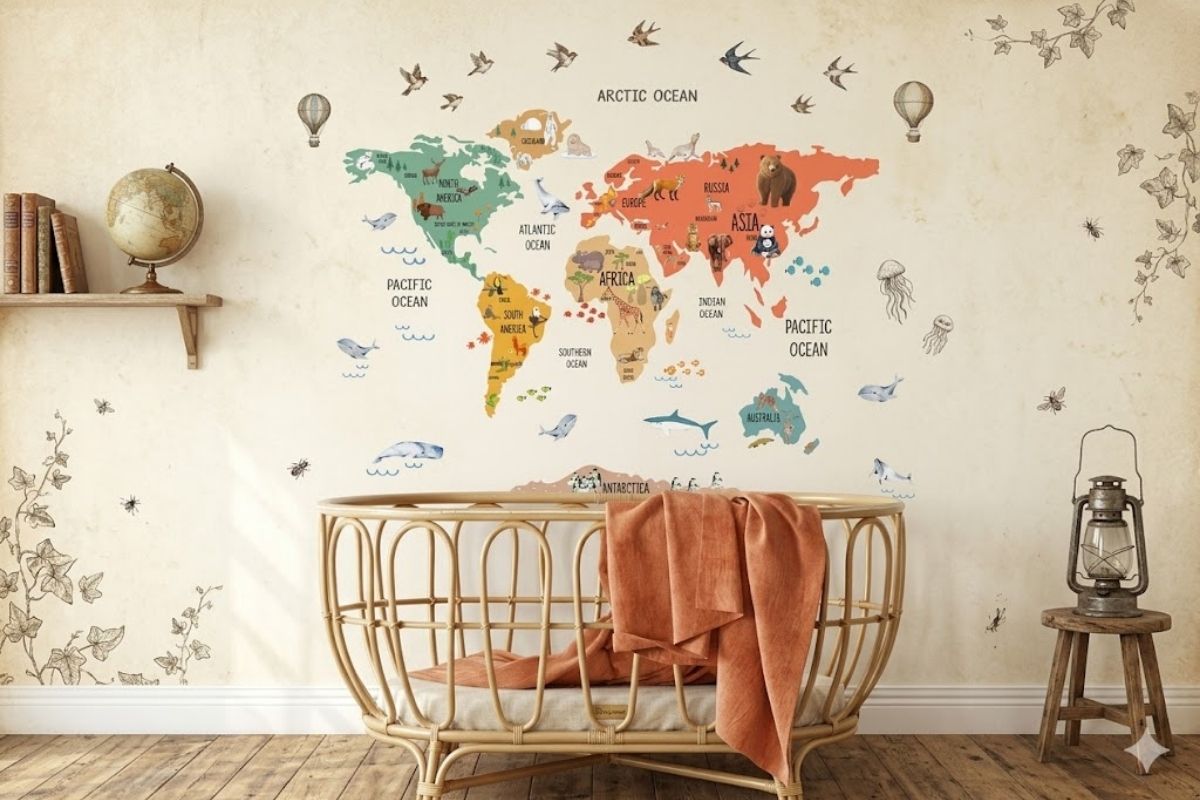
A vintage world map rug brings classic cartographic style into a nursery or kids’ room while serving as a passive geography learning tool that works across every age. Unlike standard educational rugs, vintage-style designs use aged colorways, antique typefaces, and muted cartographic tones that complement adult-designed interiors rather than clashing with them. This guide covers what defines the vintage world map aesthetic, how to choose the right size, how to style it room by room, and what to look for in construction quality that lasts from nursery to grade school.
What is a vintage world map rug?
A vintage world map rug refers to a floor covering designed for children’s spaces that reproduces the visual language of antique cartography — including aged parchment tones, serif typefaces, illustrated compass roses, and hand-drawn continent outlines — rather than the bright primary color blocking typical of standard kids’ educational rugs.
Key facts:
- Colorway: typically warm parchment, aged ochre, dusty blue, terracotta, and faded sepia — drawn from 16th–19th century map aesthetics
- Typography: serif or italic lettering for continent and country names, mimicking historical cartographic conventions
- Detail level: higher-quality vintage map rugs include country borders, ocean names, major capitals, and decorative cartouche elements
- Educational value: geography learning is embedded in the design — children absorb continent shapes, country locations, and ocean names through daily visual exposure
- Room suitability: nurseries, kids’ bedrooms, playrooms, home libraries, and gender-neutral spaces where the vintage aesthetic anchors the overall scheme
The critical distinction between a genuine vintage-style world map rug and a standard map rug relabeled as “vintage” is in the execution of the color palette and type treatment. Authentic vintage design uses desaturated, warm-toned hues and historically consistent cartographic conventions — not simply a sepia filter applied to a modern flat map.
Understanding what defines the style determines how well the rug will actually function as a design piece in the room.
Why choose a vintage world map rug for a nursery or kids’ room?
The case for a vintage world map rug in a children’s space rests on three converging arguments: design longevity, educational value, and aesthetic versatility. Each one addresses a specific concern parents face when investing in nursery or kids’ room decor.
Design longevity is the most financially compelling reason. A rug styled after antique cartography does not read as “babyish” when the child turns five, eight, or twelve. The same visual language that works in a nursery — warm parchment tones, illustrated sea creatures, serif country labels — transitions naturally into a school-age bedroom or a reading corner without requiring replacement. According to interior design industry data, parents replace overtly infantile nursery decor on average within 18–24 months of the child’s birth. A vintage-style piece sidesteps that cycle entirely.
Educational value is passive but consistent. Research in early childhood development confirms that environmental print — text and imagery encountered daily in a child’s immediate surroundings — accelerates geographic and language recognition before formal schooling begins. A vintage world map rug with countries labeled in legible type delivers that environmental print at floor level, where young children spend the majority of their time.
Aesthetic versatility addresses the design challenge most parents face: educational decor that looks intentional rather than incidental. Vintage world map rugs pair naturally with natural wood furniture, linen textiles, earthy wall colors, and the Scandinavian or boho-influenced nursery palettes that currently dominate US nursery design trends.
Those three arguments together make the vintage world map rug one of the most defensible long-term investments in a children’s room — which raises the practical question of size.
What size vintage world map rug works best for different rooms?
Selecting the correct size for a vintage world map rug determines both the visual impact of the design and the practical functionality of the floor space. The map’s cartographic detail — country labels, ocean names, compass rose — needs sufficient surface area to remain legible at floor level, which creates a minimum usable size threshold that does not apply to abstract or solid rugs.
| Room Type | Recommended Size | Why It Works |
|---|---|---|
| Small nursery (under 100 sq ft) | 4×6 ft | Centers under crib; map detail readable at seated height |
| Standard nursery (100–150 sq ft) | 5×7 or 5×8 ft | Balances visual weight; country labels fully legible |
| Kids’ bedroom / playroom | 8×10 ft | Full play-zone coverage; standard search size for this category |
| Gender-neutral shared room | 9×12 ft | Anchors larger space; gallery-worthy cartographic scale |
| Reading corner / home library | 3×5 ft | Accent placement; works under a reading chair or small table |
The 8×10 format is the most searched size in the vintage world map rug category, reflecting the default expectation for a dedicated play or learning space. At this dimension, continent labels and country borders are clearly readable from a standing position — a detail that matters when the rug is being used as an active geography reference, not just a decorative surface.
For nurseries anchored by a crib, the standard placement rule applies: extend the rug 18–24 inches beyond each side of the crib frame to create a soft landing zone. A 5×8 rug accommodates most standard crib dimensions within this margin while keeping the map proportionally balanced in the room.
With size established, the next consideration is how the vintage aesthetic integrates with specific room styles.
How to style a vintage world map rug in a nursery or kids’ room
Styling a vintage world map rug successfully depends on reading the rug’s specific colorway and using it as the palette anchor rather than an afterthought. The most common mistake is purchasing a vintage map rug after all other furnishing decisions have been made — at which point the rug’s warm parchment tones may conflict with cooler grey or white-dominant schemes.
For warm, earthy nursery palettes
(terracotta, ochre, natural linen, warm white): The vintage world map rug works as a direct extension of the palette. The aged cartographic tones mirror the wall and textile colors without competing. Pair with natural rattan furniture, linen curtains, and raw wood accents for maximum cohesion.
For Scandinavian or neutral nurseries
(white, soft grey, birch wood tones): Choose a vintage map rug in the lighter parchment or dusty blue range rather than deep sepia. The cooler neutrals in the room balance the rug’s warm undertones without creating visual tension. A single warm-toned accent — a terracotta pouf or ochre throw — bridges the two palettes.
For navy or deep-toned kids’ rooms:
A vintage map rug with deep indigo ocean areas and aged gold continent labels creates a rich, layered effect that reads as sophisticated rather than childish. This combination works particularly well in boys’ rooms or gender-neutral spaces with a travel or adventure theme.
Three universal styling principles:
- Anchor with two furniture legs minimum — place the rug so at least the front legs of the bed or primary seating rest on its edge; this grounds the piece and prevents visual floating
- Match metal tones — if the rug has gold cartouche elements, echo that tone in a lamp base or curtain rod
- Keep the wall above clean — a vintage map rug carries strong graphic weight; the wall treatment above should be simple to avoid visual competition
Dosjunior’s Kids World Map Rug Collection is designed with these pairing relationships in mind — each colorway is developed to work within real nursery and kids’ room palettes rather than in isolation.
What to look for in vintage world map rug quality and construction
Construction quality determines whether a vintage world map rug holds its visual detail and structural integrity through years of children’s room use. The cartographic print — the feature that defines the product’s value — degrades faster in low-quality construction, making fiber type and print method the two most important technical evaluation points.
Fiber type comparison:
| Fiber | Durability | Print Clarity | Washability | Feel |
|---|---|---|---|---|
| Polypropylene | High | Excellent | Machine washable | Firm, low-pile |
| Cotton-poly blend | Medium-high | Good | Machine washable (cold) | Softer hand feel |
| Wool (flat weave) | Very high | Good | Spot clean / professional | Natural, textured |
| Viscose / art silk | Low | Excellent | Spot clean only | Silky, luxury feel |
For a children’s room with active floor use, polypropylene or a cotton-poly blend provides the best combination of print durability, stain resistance, and washability. Viscose rugs reproduce vintage colorways with exceptional fidelity but are not practical in a high-spill nursery environment.
Print and dye quality indicators:
- Color depth: vintage rugs should have layered, slightly uneven tonal variation — not flat uniform color, which indicates low-resolution digital printing on inferior base fabric
- Edge definition: country borders and coastline details should be crisp at the scale of 1–2mm; blurred edges indicate low print resolution
- Colorfastness: quality rugs specify solution-dyed fibers or reactive dye processes, both of which resist fading under UV exposure and repeated washing
Pile height for nursery use: low pile (0.2–0.4 inches) is the standard recommendation for nurseries and kids’ rooms — it reduces tripping hazard for crawlers and new walkers, and it keeps the cartographic print legible rather than obscured by pile texture.
Vintage world map rug vs. standard kids’ map rug: which is better?
The choice between a vintage world map rug and a standard bright-color kids’ map rug comes down to three factors: the room’s existing design language, the child’s age range, and how long the buyer wants the rug to remain in use without replacement.
| Factor | Vintage Style | Standard Bright |
|---|---|---|
| Design lifespan | Nursery through teen years | Typically replaced by age 5–6 |
| Room palette fit | Neutral, earthy, Scandinavian | Bold primary, maximalist |
| Educational clarity | Country names in legible serif type | Simplified labels, fewer countries |
| Adult aesthetic appeal | High — works in designed interiors | Low — reads as overtly juvenile |
| Price point | Mid to premium range | Entry-level to mid range |
| Washability | Depends on fiber (polypropylene: yes) | Generally machine washable |
For parents investing in a nursery they intend to transition into a toddler and then school-age room without full redecoration, the vintage world map rug is the more economical long-term choice despite the higher initial price point. The design language does not age out.
For parents furnishing a dedicated playroom where bright stimulation is the priority and durability under heavy traffic is the main concern, a standard map rug at a lower price point may serve the space better.
The decision is not about which style is objectively superior — it is about which one fits the specific room, child, and design timeline.
Frequently asked questions
What is a vintage world map rug and how is it different from a regular kids’ map rug?
A vintage world map rug uses aged cartographic design — parchment tones, serif typefaces, illustrated compass roses, and desaturated color palettes drawn from antique map conventions. Unlike standard bright-color kids’ map rugs, the vintage style integrates into adult-designed interiors and remains visually appropriate from nursery age through the early teen years without replacement.
What size vintage world map rug fits an 8×10 nursery or kids’ room?
For a standard kids’ bedroom or playroom, an 8×10 ft rug provides full play-zone coverage and keeps cartographic detail — country labels, ocean names, continent outlines — legible from a standing position. For a smaller nursery under 100 square feet, a 5×7 or 5×8 ft rug centers well under the crib with 18–24 inches of clearance on each side.
Is a vintage world map rug washable?
It depends on the fiber. Polypropylene and cotton-poly blend vintage map rugs are machine washable on cold, gentle cycles — the most practical choice for nurseries and kids’ rooms. Wool flat-weave and viscose versions require spot cleaning or professional care. Always check the care label; solution-dyed polypropylene holds color best through repeated washing without fading the cartographic print.
Does a vintage world map rug actually help kids learn geography?
Yes, through passive environmental exposure. Early childhood development research confirms that children absorb and recognize environmental print — text and images in their daily surroundings — before formal reading instruction begins. A vintage world map rug with labeled countries, continents, and oceans provides consistent geographic reference at the level where young children spend most of their time, supporting early spatial and language recognition.
Conclusion
A vintage world map rug solves one of the most persistent challenges in children’s room design: finding an educational piece that functions as a genuine design anchor rather than a compromise. The combination of antique cartographic aesthetics, geography learning built into the surface, and design longevity that spans nursery through school-age use makes it one of the most versatile investments in a kids’ room. The right size, fiber, and colorway turn a floor covering into the defining element of an intentionally designed space.
Browse Dosjunior’s Vintage World Map Rug Collection to find the size and colorway that fits your nursery, playroom, or kids’ bedroom — each design is built for real rooms, real children, and the kind of style that does not need replacing.