

The colors surrounding a child during sleep, play, and learning have a measurable effect on mood, focus, and behavior. Color psychology for kids’ rooms is not about following trends — it is about choosing shades that match where a child is developmentally. This guide covers the science behind color perception in children, practical recommendations by age group, and how wall decor choices can reinforce or undermine the effect of your color palette
How do children perceive color differently from adults?
Children’s visual systems are not fully mature at birth. Newborns distinguish light from dark before they can differentiate hues, and full color vision typically develops within the first four to six months of life. This means the color environment matters most during early childhood, when the brain is rapidly forming associations between sensory input and emotional response.
Research in environmental psychology consistently shows that highly saturated, warm colors — reds, bright oranges — elevate heart rate and stimulate the nervous system. Cool colors such as soft blues and greens tend to have the opposite effect, lowering physiological arousal and supporting rest. For children, whose nervous systems are still learning to self-regulate, this distinction has direct consequences for sleep quality and the ability to settle after active play.
There is also a developmental shift around age six or seven, when children begin forming personal color preferences influenced by social context — peer groups, media, and gender messaging. Before that age, responses to color are more physiological than cultural, which is why age-appropriate color psychology for kids’ rooms focuses on the early years.
One practical implication: a color that works well for a toddler’s nap environment may actively work against a seven-year-old’s ability to concentrate on homework. Designing for adaptability from the start — through removable wall decor and flexible accent choices — reduces the need for full repaints as children grow.
What colors support newborns and infants (0–12 months)?
During the first year, a baby’s primary needs are sleep, feeding, and sensory stimulation in manageable doses. The color palette of the nursery should support calm wakefulness and deep sleep, not overstimulation.
Recommended shades for this age group:
- Warm whites and off-whites — neutral enough to avoid overstimulation, warm enough to feel inviting rather than clinical
- Soft sage green — associated with reduced cortisol levels in adults; in infant environments, it creates a visually restful backdrop
- Dusty blush or muted terracotta — warmer than white without the stimulating effect of saturated pinks or reds
- Pale lavender — traditionally associated with calm; works well in low-light nursery conditions
Colors to avoid at this stage include high-contrast primaries on large wall surfaces. Red, in particular, has been shown to elevate arousal even at low exposure durations. Black-and-white high-contrast patterns are appropriate for visual stimulation tools (cards, mobiles) but not for wall surfaces intended to support sleep.
The ceiling is often overlooked in nursery design. Since infants spend significant time on their backs looking upward, a ceiling painted in a tone slightly lighter than the walls creates a sense of openness without visual noise.
Which colors help toddlers aged 1–3 develop and play?
Toddlers are in a period of rapid motor and cognitive development. They need environments that support active exploration without tipping into sensory overload. The color psychology for kids’ rooms at this stage shifts toward slightly more stimulating — but still controlled — palettes.
Effective color choices for toddler rooms:
- Sunny yellow (muted, not neon) — associated with optimism and mental energy; a muted golden yellow supports alertness without aggression
- Sky blue — calming enough for sleep but bright enough to feel energizing during play; consistently one of the highest-rated colors in child preference studies across cultures
- Warm green — connects to the natural world; supports a sense of safety and belonging
- Peach or warm coral — socially stimulating without the arousal spike of red
At this stage, an accent wall strategy works well. One wall in a slightly more saturated color — paired with three neutral walls — provides visual interest for the developing eye without overwhelming the space. Wall stickers and removable decor in complementary tones let parents shift the visual emphasis as the child’s preferences emerge, without committing to a full repaint.
Avoid very dark colors (navy, charcoal) as the dominant wall color for toddlers. These shades reduce the perceived size of the room and can feel oppressive in spaces where a small child spends significant unsupervised time.
What colors support focus and learning for children aged 4–6?
As children approach preschool and early school age, the room begins to serve a dual function: it is both a sleep space and a place for structured play, early reading, and creative activity. Color choices need to support both modes without a single palette having to carry too much weight.
| Color | Effect | Best used for |
| Soft blue | Reduces distraction, supports focus | Study corner wall |
| Warm white | Neutral backdrop for imagination | Main wall surface |
| Green-grey | Balances energy without sedating | Ceiling or floor |
| Mustard yellow | Mild mental stimulation | Accent accessories |
For this age group, the most effective approach in color psychology for kids’ rooms is zone-based decoration. A reading or activity corner can be painted or decorated differently from the sleep area, using color as a visual cue that helps children shift between modes of engagement. A soft blue accent behind a small desk signals “focus time” in a way a child gradually internalizes.
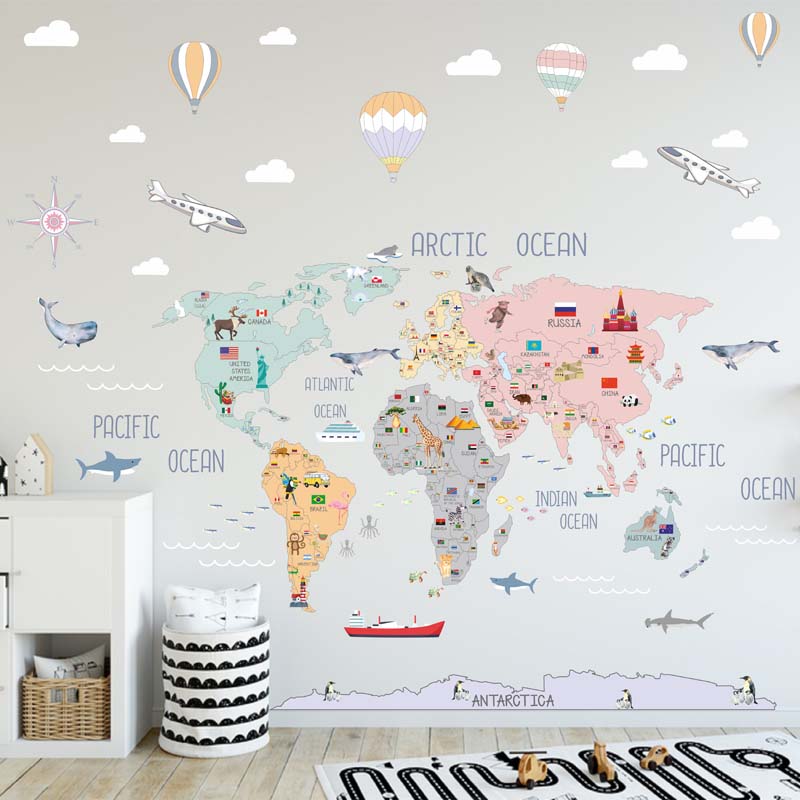
World map wall stickers in muted, educational color palettes serve a double function here — they provide visual richness and geographic familiarity without disrupting the overall calm of the space. When the map’s colors echo the room’s palette, the result feels intentional rather than chaotic.
How do color and wall decor work together?
A wall color is a backdrop, not a complete design. What hangs on or adheres to that wall either reinforces or contradicts the psychological effect of the base color. This is where wall decor — stickers, prints, textile panels — becomes a precision tool rather than an afterthought.
A few principles that apply regardless of age:
- Contrast ratio matters — decor that is too high-contrast against the wall color creates visual noise. Decor that blends entirely disappears. Aim for mid-contrast: the decor is clearly visible but does not dominate the room.
- Pattern scale — large-scale patterns (oversized maps, full-wall murals) work best in rooms with neutral wall colors. Smaller rooms with busier walls should use smaller, more contained decor.
- Color repetition — choose wall decor that repeats one or two of the room’s existing colors. This creates visual coherence without requiring design expertise.
For educational wall decor specifically, the color palette of the piece itself matters as much as its subject matter. A world map rendered in dusty, muted tones integrates into a calm bedroom palette. The same map in saturated primary colors functions better in a playroom or learning space with higher visual energy.
Removable wall stickers allow parents to test combinations before committing. Applying a sticker to a corner of the room and observing the child’s reaction over a few days is a more reliable method than deciding from a product image alone.
Frequently Asked Questions
What is the best color for a child’s bedroom wall?
Soft blue and sage green are the most consistently recommended colors across child development and environmental psychology research. Both support rest and reduce overstimulation. The best choice depends on the child’s age and how the room is used — a toddler’s room benefits from warmer tones, while a school-age child’s study space benefits from cooler ones.
Does red really affect children’s behavior?
Yes. Red increases physiological arousal — heart rate and neural activity rise with red exposure, even at short durations. For children who already have difficulty settling or sleeping, red as a dominant wall color can meaningfully worsen the problem. As a small accent, its effect is negligible.
Can dark colors work in a kids’ room?
Dark colors can work as accents — a single deep navy or forest green wall — when balanced with lighter furniture and good natural or artificial lighting. As the dominant color across three or four walls, they reduce perceived room size and can feel confining for young children who spend significant time in the space.
At what age should I let my child choose their room color?
Most child development specialists suggest involving children in color decisions from around age five or six, when personal preferences are stable enough to reflect genuine taste rather than momentary fixation. Offering two or three pre-selected options (rather than a full color wheel) keeps the choice within a range that still works developmentally.