

5 Profound Benefits of World Maps for Children
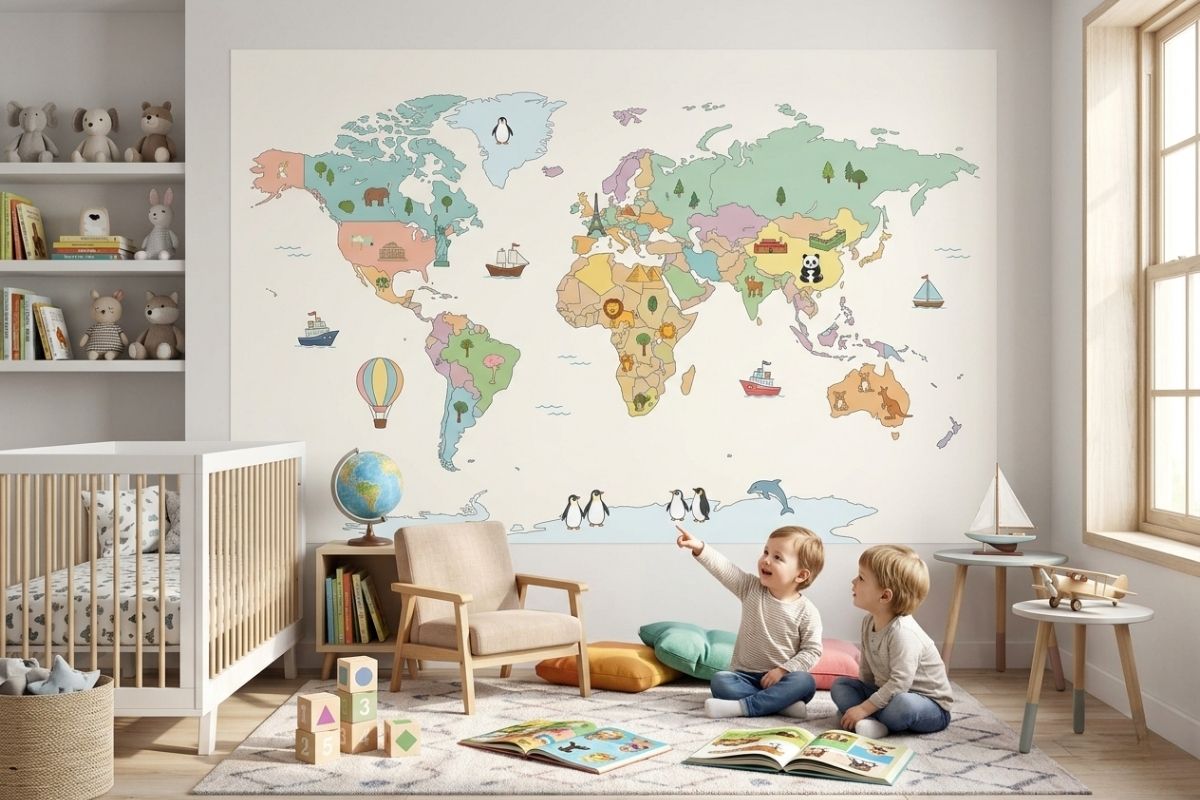
Why should you put a world map in a child’s room? Beyond decoration, a world map is a multi-dimensional educational tool that enhances spatial reasoning, boosts geographical literacy, and fosters global empathy. It serves as a visual anchor for “passive learning,” helping children naturally memorize continents, wildlife, and cultural landmarks while sparking curiosity about the world’s diversity and environmental ecosystems.
Introduction: Why Walls Matter in Early Development
When we think about early childhood education, we often picture books, flashcards, and building blocks. However, one of the most powerful teaching tools is often overlooked: the environment itself. In pedagogical terms, the environment is often called the “third teacher.”
The walls of a nursery or playroom are not just boundaries of a room; they are vast canvases for imagination. A world map, when designed with both artistic whimsy and geographic accuracy, becomes a lifelong reference point. In this comprehensive guide, we will explore the deep cognitive, emotional, and academic benefits of integrating a world map into your child’s living space.
1. Cognitive Architecture: Developing Spatial Intelligence
Spatial intelligence—the ability to visualize and understand the physical relationship between objects—is a foundational skill for STEM (Science, Technology, Engineering, and Math) fields.
Understanding Scale and Proportion
For a toddler, the world is their home and their backyard. A world map introduces the concept of “The Big Picture.” By observing a map, children begin to grasp that a tiny island is different from a massive continent. They learn to process scale—understanding that while a house is big, a city is bigger, and an ocean is vast.
Mental Mapping
Daily exposure to a map helps children develop “mental maps.” When they hear a story about a penguin, their brain automatically navigates to the bottom of the map (Antarctica). This cognitive retrieval process strengthens neural pathways associated with memory and logical reasoning.
2. Geographical Literacy and Scientific Discovery
Geographic literacy is more than just knowing where countries are; it’s about understanding how our planet works.
Zoology and Habitat Association
A map that features animals (like those in the Dos Junior collection) acts as a child’s first biology lesson.
- The Arctic vs. Antarctica: Children learn early on that polar bears and penguins live on opposite poles.
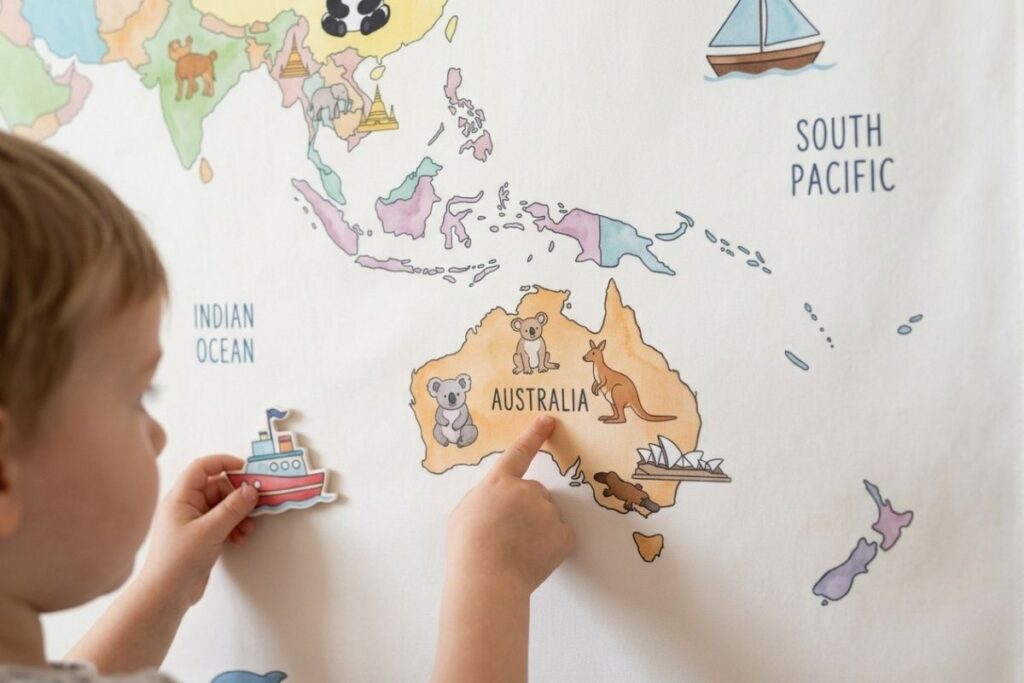
- Biodiversity: Seeing a kangaroo in Australia and a lemur in Madagascar teaches them about unique ecosystems that exist nowhere else on Earth.
Introduction to Earth Sciences
As children grow, the map evolves with them. It becomes a tool to discuss:
- Climates: Why is the middle of the map (the Equator) usually filled with rainforests while the top is icy?
- Oceans and Water Cycles: Understanding that the majority of our planet is covered in water.
3. Raising a Global Citizen: Cultural Empathy and Diversity
In the 21st century, cultural intelligence (CQ) is as important as IQ. A world map is the first step toward raising an empathetic, globally-aware individual.
Breaking the “Bubble”
Children who grow up seeing the diversity of the world are less likely to develop “in-group” biases. A map shows them that their way of life is just one of many.
Visualizing History and Current Events
When a child sees a landmark like the Taj Mahal or the Statue of Liberty on their wall, they start to associate physical places with human achievements. Later, when they learn about these places in school, they have a pre-existing visual “folder” in their brain to store that new information.
4. Linguistic Milestones: Vocabulary and Early Literacy
A world map is essentially a giant word-wall. It is packed with complex nouns that you won’t find in standard “cat-and-hat” books.
Phonetic Practice with Global Names
Reading words like “Mediterranean,” “Himalayas,” or “Scandinavia” challenges a child’s phonetic abilities. It introduces them to the sounds of different languages and cultures.
Contextual Reading
For a child just learning to read, the map provides contextual clues. They see a picture of a pyramid and the word “Egypt” next to it. This association helps them decode words faster and improves reading comprehension.
5. The Psychological Impact: Curiosity and “Growth Mindset”
Beyond the academic benefits, there is a profound psychological advantage to having a world map in a child’s room: The cultivation of wonder.
Inspiring Adventure
A map is a promise of future adventures. It tells the child, “The world is huge, and it is waiting for you.” This inspires a sense of bravery and curiosity. Instead of fearing the unknown, they learn to be excited by it.
Passive Learning vs. Active Teaching
The beauty of a wall decal map is that it provides passive learning. The child doesn’t feel like they are “studying.” They are just playing, looking, and dreaming. This stress-free acquisition of knowledge is often the most permanent form of learning.
6. Practical Considerations: Choosing the Right Map
To maximize these benefits, parents must choose a map that serves both as art and as an educational tool.
Accuracy Matters
While whimsical illustrations are great for engagement, the borders and ocean placements should be geographically consistent. This ensures that the child doesn’t have to “unlearn” incorrect information later in life.
Durability and Safety
In a child’s environment, materials matter.
- Non-Toxic Materials: Look for PVC-free and chemical-free options.
- Low-Tack Adhesives: For renters or parents who like to rearrange furniture, a “peel and stick” textile material is superior to permanent vinyl.
Conclusion: Investing in Your Child’s Future
A world map is one of the few investments in nursery decor that yields long-term dividends. It bridges the gap between home and the world, between play and education, and between the present and the future. By placing the world on your child’s wall, you are giving them the greatest gift of all: The freedom to explore.
Frequently Asked Questions (FAQ)
1. Will wall decals damage my nursery paint?
No. High-quality nursery decals are made from low-tack, water-based adhesives specifically designed for interior walls. When applied to a smooth, dry surface and removed slowly, they leave no residue and do not peel the paint, making them ideal for rental homes.
2. Is the geographical information on these maps accurate?
Yes. While the designs are artistic and child-friendly, geographical consistency is a priority. Continent borders, ocean placements, and landmark locations are designed to be reliable learning tools so that children gain a correct understanding of world geography.
3. Are textile-based maps better than vinyl stickers?
Textile (fabric) wall decals are generally superior for nurseries because they are PVC-free, breathable, and have a matte, premium finish. Unlike vinyl, textile decals do not shrink or curl over time and offer a much softer look that complements nursery fabrics.
4. Can I apply a world map decal on textured walls?
Decals perform best on smooth or lightly textured surfaces. If your wall has a very deep or “popcorn” texture, the adhesive may not bond perfectly. In such cases, we recommend textile wall hangings (tapestries), which provide the same educational aesthetic without the need for adhesive.
5. How do I clean a world map wall decal?
Maintaining a map is simple. You can gently wipe the surface with a damp, soft cloth to remove dust or fingerprints. Avoid using harsh chemicals or abrasive sponges, as these can damage the protective coating and the vibrant colors of the illustrations.
6. At what age should I introduce a world map to my child?
It is never too early! For infants, maps provide high-contrast visual stimulation. For toddlers (ages 2-4), maps become a tool for animal recognition. By school age (5+), they serve as a primary resource for learning geography, history, and environmental science.
Bring the World to Your Child’s Room!
It’s never too late to fuel your little explorer’s imagination and transform their room into a hub of discovery. Explore Dos Junior’s eco-friendly and textile-based World Map Collection, designed for every age—bring the adventure to your walls!