
How to Install Nursery Wall Decals: The Ultimate Professional Guide
Transforming a nursery into a sanctuary of imagination and growth is one of the most rewarding projects for an expectant or new parent. Learning how to install nursery wall decals correctly is the key to achieving a professional and lasting result in your child’s space. While the aesthetic appeal of a wall decal is immediate, the longevity, safety, and professional appearance of the design depend entirely on a meticulous installation process. High-quality decals, particularly those designed with premium materials like those found at Dos Junior, are engineered for durability, but they require a sophisticated approach to ensure the adhesive creates a permanent-looking bond without damaging the underlying surface.
Phase 1: The Technical Science of Wall Preparation
The success of a wall decal installation is decided long before the material touches the surface. A wall is not merely a flat plane; it is a porous, reactive environment that interacts with adhesives on a molecular level. Failure to understand these interactions is the primary cause of peeling and bubbling.
1. The Micro-Contaminant Deep Clean
Even in a house that appears spotless, walls are subject to a constant accumulation of microscopic debris. This includes airborne dust, skin oils from previous touchpoints, and, most critically, chemical residues from household cleaning products or candles. These contaminants create a “release layer” that prevents the decal’s adhesive from fully “wetting out” or bonding with the paint.
- The Cleaning Protocol: Use a lint-free microfiber cloth to wipe down the entire intended area. If there is visible grime, a solution of warm water and very mild dish soap is permissible. However, you must strictly avoid any “easy-clean” or “scuff-resistant” detergents, as these often contain silicone or waxes that permanently repel adhesives.
- The 48-Hour Dehydration Window: If you use any moisture during cleaning, the wall must be allowed to dry for a minimum of 24 to 48 hours. While the surface may feel dry to the touch within an hour, moisture can remain trapped within the pores of the drywall or plaster. Applying a decal over this moisture can lead to bubbling as the water evaporates, or even worse, it can foster the growth of sub-surface mold in a nursery environment.
2. The Fresh Paint and Outgassing Protocol
One of the most frequent causes of installation failure is applying decals too soon after a room has been repainted. Paint undergoes a complex chemical process called “curing,” which is distinct from simply “drying”.
- Understanding Outgassing: As paint cures, it releases Volatile Organic Compounds (VOCs) and other gases. If a decal is placed over curing paint, these gases become trapped, leading to significant bubbling and eventually causing the decal to fall off, often taking the new paint with it.
- The Waiting Period: Experts and manufacturers recommend a waiting period of at least 30 to 60 days after a final coat of paint is applied. Even “low-VOC” or “zero-VOC” paints require this curing time to ensure the chemical bond is stable enough to support an adhesive application.
Phase 2: Environmental Variables and Material Acclimatization
Wall decals are made of sensitive polymers—either vinyl or fabric-based—that react to the temperature and humidity of their surroundings. Managing these environmental factors is crucial for a smooth application.
1. Thermal Equilibrium and Acclimatization
When your decals arrive, they have likely been subjected to various temperatures during shipping. Applying a cold decal to a warm wall, or vice versa, causes the material to expand or contract immediately after application, resulting in edge-lifting or wrinkles.
- The 24-Hour Rule: Unbox your decals and lay them flat in the nursery where they will be installed for at least 24 hours. This allows the material to reach “thermal equilibrium” with the wall surface, ensuring the material remains stable during and after the sticking process.
2. Managing Humidity and Surface Temperature
Adhesives are highly sensitive to the moisture content in the air. High humidity (above 60%) can make the adhesive overly aggressive and difficult to reposition, while very low humidity can make it brittle.
- Ideal Conditions: Aim for a room temperature between 18°C and 25°C. If the wall is particularly cold—common on exterior-facing walls in winter—the adhesive will not “grab” the surface effectively. In such cases, gently warming the wall with a hairdryer on a low setting prior to application can significantly improve initial tack.
Phase 3: Strategic Planning and Layout Composition
Before removing the backing paper, you must treat the wall like a gallery canvas. Proper planning prevents the frustration of a slanted design or a layout that doesn’t fit the room’s furniture.
1. The Painter’s Tape Mock-up
Do not rely on visual estimation alone. Use low-tack painter’s tape to hang the decals—with the backing paper still attached—in their desired positions.
- Perspective Analysis: Step back to the room’s entrance and view the layout from different angles. Consider how the decals interact with the crib, light switches, and changing tables. This is the time to make adjustments without risking the adhesive’s integrity.
- The Leveling Process: For larger elements like world maps, horizons, or name decals, a spirit level or a digital leveling app is essential. Even a 1-degree tilt can become a glaring error once the design is fully applied.
2. Marking Anchors
Once the layout is perfected, use a pencil to make very light “guide dots” at the corners or top edges of each piece. These anchor points will serve as your guide when you begin the permanent application, ensuring that the final placement matches your approved mock-up exactly.
Phase 4: The Step-by-Step Execution for a Professional Finish
This phase requires patience and a steady hand. The goal is to apply the decal while simultaneously removing air to create a seamless, “painted-on” look.
Step 1: The Top-Hinge Technique
For larger decals, do not remove the entire backing paper at once. Instead, peel back only the top 2 to 3 inches. Fold the backing paper sharply behind the decal. Align the exposed adhesive with your pencil guide dots and press it firmly against the wall. This creates a “hinge” that keeps the rest of the decal aligned and out of the way as you work.
Step 2: Continuous Squeegee Motion
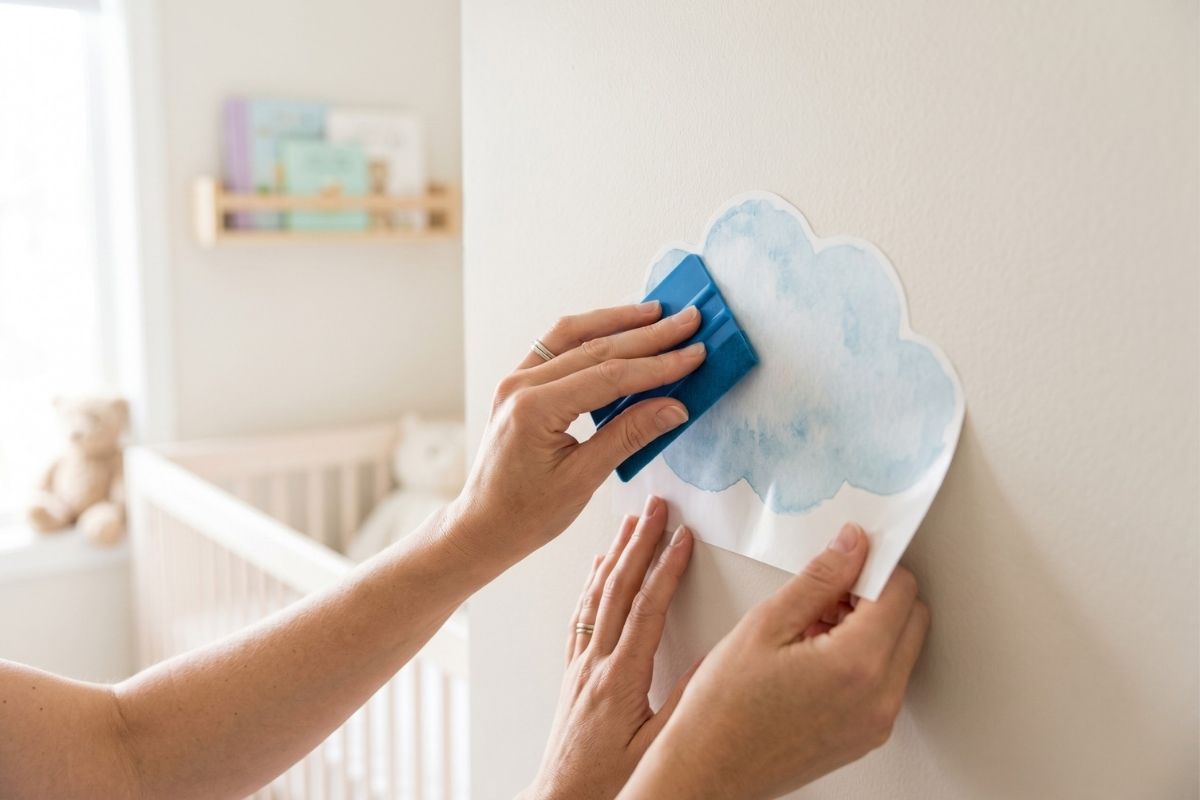
As you slowly pull the remaining backing paper downward with one hand, use a squeegee (or a credit card wrapped in a soft microfiber cloth) with the other hand.
- The Motion: Always work from the center of the decal outward toward the edges. Use overlapping horizontal strokes. This technique ensures that air is pushed to the perimeter and does not get trapped in the center to form bubbles.
- Fabric vs. Vinyl: If you are using fabric-based decals, be extra gentle with the squeegee to avoid stretching the fibers. Fabric is more forgiving with bubbles but can lose its shape if pulled too hard during application.
Step 3: Removing the Transfer Sheet
If your design includes a transparent transfer sheet on top, the removal process is critical.
- The 45-Degree Peel: Do not pull the transfer tape toward you. Instead, peel it back slowly at a 45-degree angle, keeping it as flush against the wall as possible. This minimizes “lift” and ensures the decal stays anchored to the wall. If any part of the decal begins to lift with the tape, stop immediately, rub it back down firmly, and continue even more slowly.
Phase 5: Troubleshooting and Post-Installation Care
Even with a perfect application, certain variables can lead to minor issues. Knowing how to troubleshoot these will preserve the life of your decor.
1. Eliminating Stubborn Bubbles
If you find a bubble after the installation is complete, do not try to “crush” it with your thumb, as this can stretch the material.
- The Needle Trick: Use a very fine sewing needle to prick a tiny hole in the center of the bubble. Gently push the air out toward the hole with your finger. The hole will be invisible to the eye, but the decal will now lie perfectly flat against the wall.
2. Edge Lifting and Heat Setting
In rooms with high-texture walls or varying temperatures, edges may occasionally lift.
- The Solution: Use a hairdryer on the lowest heat setting to warm the lifted edge for 5-10 seconds. This softens the adhesive. Immediately press it back into the wall using a soft cloth and hold it for 30 seconds. The heat helps the adhesive “flow” into the microscopic textures of the wall for a much stronger bond.
3. Cleaning and Maintenance
Premium decals, especially the PVC-free options at Dos Junior, are durable but should be treated with care.
- The Routine: Dust the decals regularly with a dry, lint-free cloth. Avoid using any liquid cleaners, especially those containing alcohol or ammonia, as these can degrade the inks over time. If a smudge occurs, a slightly damp cloth (water only) used with a gentle dabbing motion is the safest approach.
Phase 4: Material Safety and The Dos Junior Standard
In a nursery, the health of the environment is just as important as its beauty. Standard mass-market decals are often made of vinyl (PVC), which can release phthalates and Volatile Organic Compounds (VOCs) over time.
1. The Importance of PVC-Free Materials
PVC-free decals are the gold standard for children’s rooms. They do not “outgas” harmful chemicals, ensuring the air your baby breathes is clean. Furthermore, textile-based decals offer a sophisticated matte finish that doesn’t reflect glare from nursery lamps, providing a more calming visual environment.
2. Educational and Developmental Value
A well-installed decal is more than a decoration; it is a developmental tool. Large-scale world maps, celestial charts, or nature scenes provide early visual stimuli that encourage curiosity and cognitive growth. When these elements are installed correctly—without the distraction of peeling edges or wrinkles—they become an integrated part of the child’s world, fostering a sense of wonder and learning from day one.
3. Removal and Sustainability
One of the greatest advantages of high-quality “Peel & Stick” technology is its removability. Whether you are a renter or simply plan to update the room as your child grows, professional-grade decals are designed to be removed without leaving a sticky residue or stripping the paint. To remove, simply start at a corner and pull back slowly at a 180-degree angle.
Conclusion: How to Install Nursery Wall Decals
Mastering the installation of nursery wall decals is a labor of love that pays dividends in both style and safety. By following this exhaustive 2,000-word guide—from the initial chemical cleaning of the wall to the final 45-degree peel of the transfer sheet—you ensure that your Dos Junior decor serves as a perfect, safe, and inspiring backdrop for your child’s earliest years. A professional installation ensures that your nursery remains a beautiful, healthy, and serene space where memories are made and dreams begin.
Ready to choose the perfect theme for your nursery?
[Explore the Dos Junior Premium Collection]