

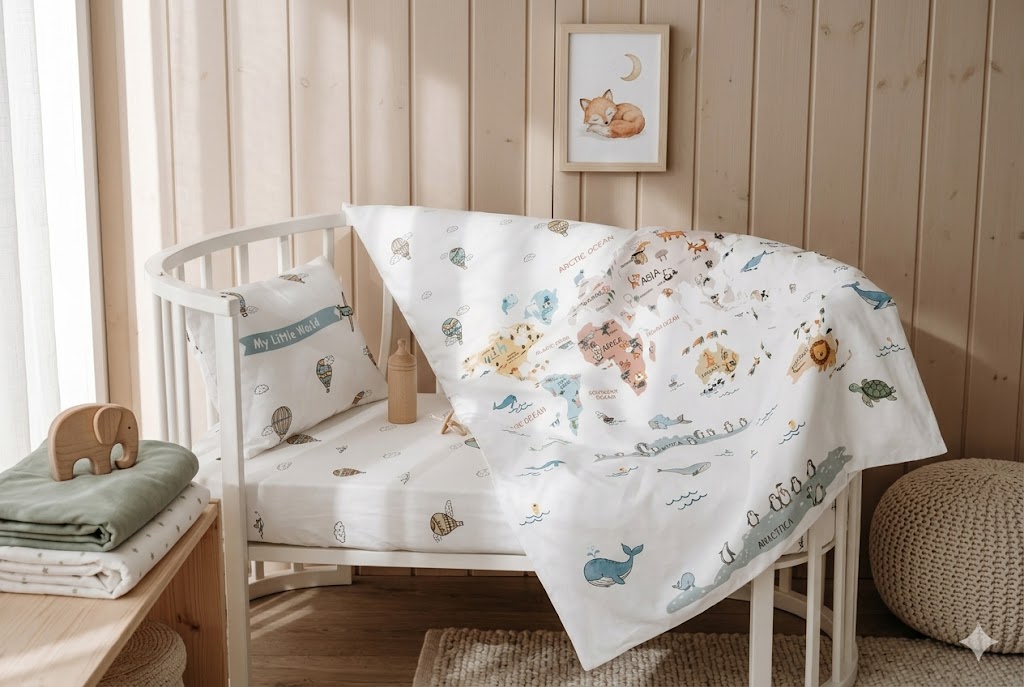
An organic cotton crib bedding set is the safest sleep surface choice for a newborn, replacing synthetic fibers and chemical finishes with breathable, certified-pure materials that rest against a baby’s skin for up to 16 hours every day. The difference between conventional and organic crib bedding is not marketing — it is measurable in the certifications, fiber processing methods, and dye safety standards that define each product. This guide covers what those certifications mean, how to evaluate thread count and weave for breathability, how to layer for every season, and what to look for in a complete nursery bedding set.
What is an organic cotton crib bedding set?
An organic cotton crib bedding set refers to a curated collection of nursery sleep textiles — typically including fitted sheets, a quilt or blanket, and a pillowcase — made from cotton grown without synthetic pesticides, herbicides, or genetically modified seeds, and processed without chlorine bleach or formaldehyde-based finishes. The organic designation applies to the entire production chain, not just the raw fiber.
Key facts:
- GOTS (Global Organic Textile Standard): covers both fiber origin and processing; prohibits toxic dyes and finishing chemicals
- OEKO-TEX Standard 100: tests the finished product for harmful substances; does not govern farming practices
- GOTS + OEKO-TEX together provide the most comprehensive safety confirmation available for baby textiles
- Typical thread count range: 200–400 TC for fitted crib sheets; lower counts increase breathability, higher counts increase softness
- Standard crib sheet fit: designed for mattresses 27.5 × 51.5 inches with a depth of 4–6 inches
The distinction matters because a fabric can be labeled “natural” or “cotton-blend” while still containing polyester fill, azo dyes, or formaldehyde resins used to prevent wrinkling. For a newborn sleeping 14–16 hours daily, those chemicals represent prolonged dermal exposure — the precise risk that certified organic nursery bedding eliminates.
Understanding certification is the foundation; the next step is evaluating material quality in practical terms.
Why does organic cotton matter for newborn sleep safety?
Newborn skin is structurally different from adult skin. According to dermatology research, the skin barrier in infants under 12 months is significantly thinner and more permeable, meaning chemical residues in textiles absorb transdermally at a higher rate than in older children or adults. This is the clinical basis for the recommendation to use certified organic baby bedding from birth.
Conventional cotton is one of the most chemically intensive crops grown globally. Industry data indicates that cotton accounts for roughly 16% of global insecticide use despite covering only 2.4% of arable land. Those residues persist through fiber processing unless specifically removed — and standard textile manufacturing does not require their removal.
Organic cotton farming eliminates that exposure at the source. But farming certification alone is insufficient. The finishing process — where fabric is softened, whitened, or treated for wrinkle resistance — introduces a second category of chemical risk. Formaldehyde resins, used in permanent-press treatments, are classified as a known human carcinogen by the International Agency for Research on Cancer (IARC). GOTS-certified processing prohibits their use entirely.
For parents comparing an organic cotton crib bedding set against conventional alternatives, the safety differential is not theoretical. It is documented, tested, and verifiable through certification labels printed on the product.
Breathability is the second safety dimension — and it connects directly to how the fabric is woven.
What thread count is best for a breathable crib sheet?
Thread count is frequently misunderstood as a quality indicator when it is actually a weave density measurement. For a baby crib sheet, lower thread counts (180–280 TC) in a percale weave provide superior breathability — a measurable clinical priority for infant sleep safety, since overheating during sleep is a recognized risk factor in pediatric guidelines.
| Weave Type | Thread Count | Breathability | Feel |
|---|---|---|---|
| Percale | 180–280 TC | High | Crisp, cool |
| Sateen | 300–400 TC | Moderate | Silky, smooth |
| Jersey knit | N/A (weight-based) | High | Stretchy, soft |
| Muslin (4-layer) | N/A (gauze) | Very high | Light, airy |
Percale-weave organic cotton is the most widely recommended choice for year-round nursery use in temperate US climates because it does not trap heat regardless of room temperature fluctuation. Jersey-knit organic cotton, made from a circular-knit structure, offers stretch that makes fitted sheet application easier and reduces the gap risk between mattress edge and sheet — a safety-relevant detail for crib use.
Muslin (gauze-weave) organic cotton has gained significant traction in the US market for its multi-layer breathability and rapid moisture-wicking. A 4-layer organic muslin quilt provides warmth equivalent to a mid-weight blanket while maintaining airflow — making it suitable as the primary sleep layer without overheating risk.
Thread count and weave inform which individual pieces to prioritize — the next section addresses how to build a complete, season-ready bedding set.
What should a complete organic nursery bedding set include?
A complete organic cotton crib bedding set for a newborn nursery requires fewer pieces than most retail bundles suggest. Pediatric sleep safety guidelines from the American Academy of Pediatrics (AAP) recommend a bare sleep environment for infants under 12 months — meaning no loose quilts, pillows, or bumpers inside the crib during sleep. Understanding this distinction is essential before purchasing a full set.
The practical composition of a safe, complete organic nursery bedding set:
- 2–3 fitted organic cotton crib sheets: rotating sets allow for immediate replacement after nighttime changes without doing laundry at 3 AM
- 1–2 organic cotton swaddle blankets: used outside the crib for feeding, floor time, and stroller use; not placed inside the sleep space
- 1 organic cotton quilt or toddler blanket: introduced after 12 months when the AAP sleep environment guidelines permit loose bedding
- 1 waterproof mattress protector (organic cotton top layer): protects the mattress from fluid penetration while maintaining the organic contact surface
Many retail bundles include a bumper pad and decorative pillow. Both are considered unnecessary and potentially hazardous for crib sleep by the AAP. A genuinely safety-conscious organic nursery bedding collection omits these items or labels them clearly for decorative use only.
Dosjunior’s approach — designing products that educate and inspire while meeting the highest safety standards — aligns with this philosophy: every piece in a bedding collection should earn its place in the nursery.
With the components established, seasonal layering determines how the set performs across the full year.
How to layer organic crib bedding for every season
Seasonal layering with organic cotton crib bedding follows a consistent principle: adjust the number of breathable layers rather than switching to heavier synthetic materials. Organic cotton’s natural thermoregulatory properties — the fiber absorbs up to 27 times its weight in moisture before feeling damp — make it effective across a wider temperature range than polyester or microfiber alternatives.
For US nursery conditions, a practical seasonal guide:
- Summer (room temp 68–72°F): one fitted percale sheet only; no additional layer inside the crib for infants under 12 months
- Fall/Spring (room temp 65–68°F): fitted sheet plus a wearable sleep sack (1.0–1.5 TOG rating) over the infant; the crib surface remains bare
- Winter (room temp 61–65°F): fitted sheet plus a higher-TOG sleep sack (2.0–3.5 TOG); for toddlers over 12 months, an organic cotton quilt may be added inside the crib
The TOG (Thermal Overall Grade) rating system, standard in European and increasingly US baby markets, provides a quantified measure of warmth that removes guesswork from seasonal layering decisions. Pairing a TOG-rated sleep sack with a certified organic cotton crib sheet keeps the sleep surface safe, consistent, and temperature-appropriate regardless of season.
A well-chosen organic nursery bedding set is a year-round system, not a single-season purchase — which makes the per-use cost significantly lower than it may appear at the initial price point.
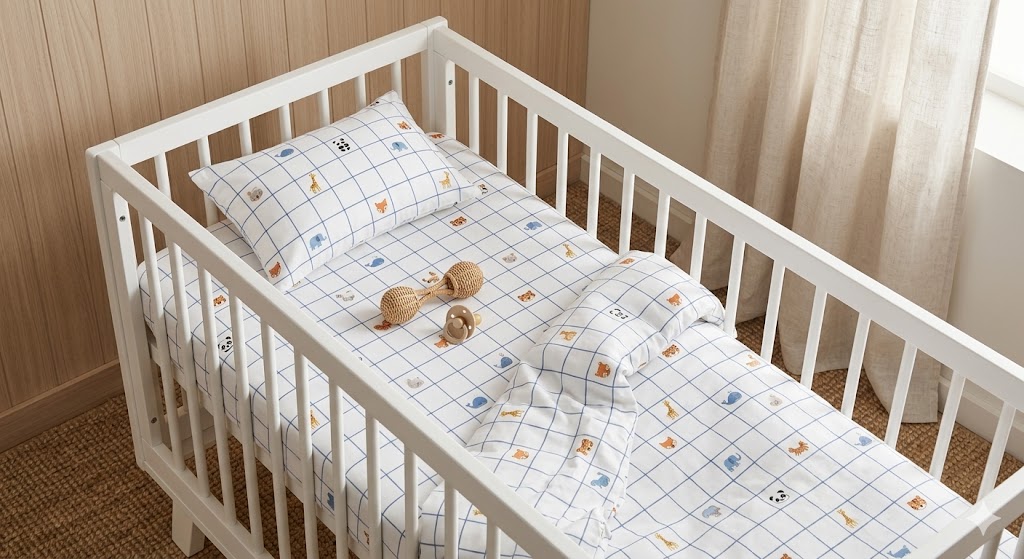
Frequently asked question
What certifications should an organic cotton crib bedding set have?
Look for GOTS (Global Organic Textile Standard) certification, which covers both the farming and manufacturing process, and OEKO-TEX Standard 100, which tests the finished product for over 100 harmful substances. Together, these two certifications confirm safety at every production stage — from raw cotton field to the finished sheet on the crib mattress.
Is organic crib bedding worth the higher price for a newborn?
Yes, for parents prioritizing skin safety. Newborn skin is thinner and more permeable than adult skin, meaning chemical residues in conventional textiles absorb at higher rates. Certified organic cotton bedding eliminates formaldehyde resins, synthetic dyes, and pesticide residues. The cost premium typically ranges from 30–60% over conventional options, but the contact hours — up to 16 per day — justify the investment.
How do you wash organic cotton crib sheets without shrinking them?
Wash on a cold or 30°C gentle cycle using a dye-free, fragrance-free detergent. Avoid hot water above 40°C, which causes organic cotton fibers to contract by up to 5% in the first wash. Tumble dry on low heat below 50°C or air dry flat. Pre-washed organic cotton sheets have already undergone controlled shrinkage and will hold size more consistently after the first home wash.
What is the difference between organic cotton crib bedding and regular cotton crib bedding?
Regular cotton is grown with synthetic pesticides and processed with chemical finishes including formaldehyde resins and chlorine bleach. Organic cotton is grown without synthetic inputs and processed under certified standards that prohibit those chemicals. The finished fabric is not visually different, but the chemical residue profile is substantially lower — confirmed by GOTS and OEKO-TEX testing on the final product.
Conclusion
An organic cotton crib bedding set is one of the most evidence-backed purchases a parent can make for a newborn’s sleep environment — the combination of GOTS-certified fiber sourcing, breathable percale or muslin weave construction, and chemical-free processing addresses the real, documented risks of conventional nursery textiles. Choosing the right set means verifying certifications, selecting weave for breathability, and building a safe seasonal layering system rather than simply filling a crib with decorative pieces. The nursery should be a space that inspires and protects in equal measure.
Explore Dosjunior’s Organic Nursery Bedding Collection to find certified sets designed for both safety and the kind of thoughtful aesthetic that makes a child’s room genuinely beautiful.