

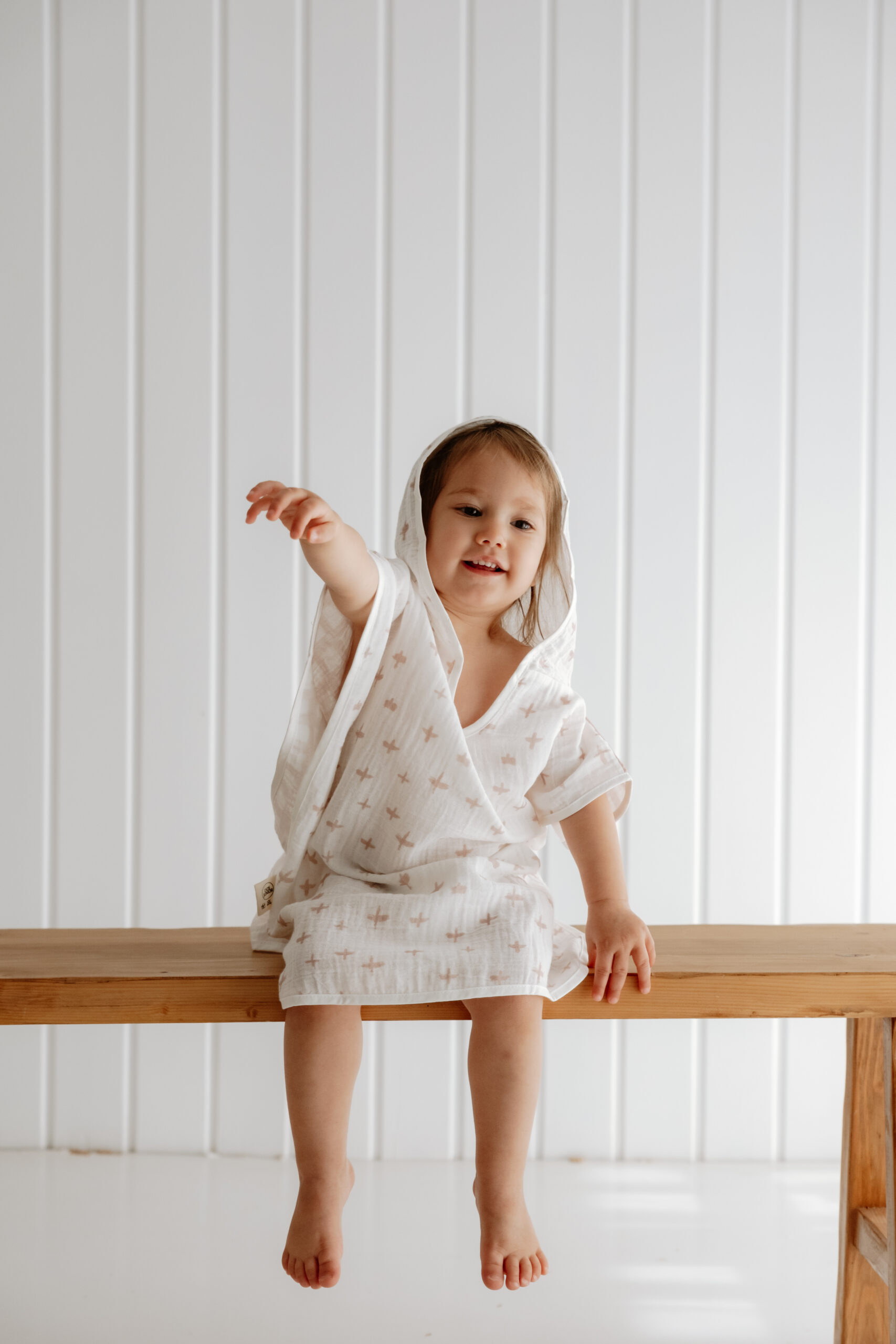
A poncho is one of the few garments that works for the toddler who won’t keep a jacket on and the five-year-old who needs something quick to pull on between activities. Kids’ ponchos go on and come off without a fight — no buttons, no zips — and they handle a wider range of temperatures than most single-layer pieces.
At Dos Junior, our muslin ponchos started as a simple idea: a soft, breathable layer your little one can manage on their own. This guide covers the real, practical case for keeping a poncho in your child’s wardrobe, how different fabrics actually perform, and how to choose one that fits long enough to be worth it.
What makes a poncho different from other kids’ outerwear?
A poncho is an unshaped (or barely shaped) panel of fabric — rectangular or triangular — with an opening for the head. No sleeves. No fastenings. No structured shoulder seams. That simplicity is exactly why it works so well for children.
In everyday terms, no sleeves and no fastenings means:
- Your child can dress themselves. From around age two, a toddler can pull a poncho on and off alone — which feeds the fierce independence of those years.
- Nothing catches. No zip teeth to snag on clothing or skin.
- Free arm movement. Nothing restricts climbing, reaching, or carrying that all-important toy.
- Forgiving sizing. One size typically fits across a 12–18 month stretch.
That independence matters more than it sounds. Outerwear your child can manage alone takes the friction out of every transition — heading out the door, coming back in, before and after the morning drop-off. It’s a small daily moment that either causes a meltdown or doesn’t.
Ponchos also pack flat and keep their shape, so they’re easy to toss in a bag as a backup layer or a travel companion.
Which fabrics are used in kids’ ponchos, and how do they perform?
Fabric decides everything: how a poncho performs across seasons, how soft it feels against your child’s skin, and how it holds up wash after wash. For children’s clothing, the two things that matter most are durability and skin-safety — then warmth.
| Fabric | Warmth | Breathability | Wash durability | Best season |
|---|---|---|---|---|
| Muslin (woven cotton) | Low–Medium (layerable) | Very high | High — softens with every wash | Spring, summer, mild autumn + year-round layering |
| Merino wool | High | High | Medium | Autumn / winter |
| Cotton knit | Low–Medium | High | High | Spring / summer |
| Cotton-acrylic blend | Medium | Medium | High | All seasons |
Muslin is our material of choice, and there’s a reason for it. Woven from fine cotton threads in an open, gauzy structure, muslin is exceptionally breathable — it moves air, so your child stays comfortable whether the afternoon warms up or cools down. It’s buttery soft from the first wear and, unlike most fabrics, gets softer every time you wash it. It’s gentle enough for the most sensitive baby skin, and it layers beautifully: a muslin poncho over a long-sleeve top carries a child through a cool spring morning, then comes off the moment the sun does its job.
Merino wool is the warmest natural fiber and a good cold-weather choice, though it costs more and needs careful washing. Cotton knit and cotton-acrylic blends are practical, durable everyday options. Each has its place — the point isn’t that one fabric wins everything, but that you choose for the season and for how the fabric feels on your child.
“Breathability is the thing parents underestimate,” says Züleyha Demir, our founder and a textile expert with more than ten years of experience. “Children run hot, they’re always moving, and they go in and out of heated rooms all day. A breathable woven layer like muslin keeps them comfortable across that whole range — that’s why I designed our ponchos in it.”
Whatever fabric you choose, check for the absence of harmful dyes and finishes. Reputable makers will hold OEKO-TEX Standard 100 certification (or an equivalent), which confirms the fabric has been tested against a long list of harmful substances. Every Dos Junior textile is made with non-toxic, baby-safe materials and finished by hand in our Texas studio.
Want to feel the difference for yourself? Shop our muslin poncho collection.
How do you size a kids’ poncho correctly?
Because a poncho is unshaped, sizing works differently from a fitted jacket. The number that matters isn’t chest circumference — it’s the width and drop of the panel relative to your child.
Too wide, and it bunches at the shoulders and gets in the way of their arms. Too narrow, and it pulls across the chest into an accidental fitted look. The drop — shoulder opening to hem — decides how much coverage your child gets.
A rough guide by age:
- 12–24 months — shoulder width about 30–35 cm (12–14 in), drop 30–35 cm (12–14 in); the hem should sit at or just below the hip.
- 2–4 years — shoulder width 35–40 cm (14–16 in), drop 35–40 cm (14–16 in).
- 4–6 years — shoulder width 40–45 cm (16–18 in), drop 40–48 cm (16–19 in).
Treat these as starting points. If your child is taller or heavier than average for their age, size up. If you want the poncho as a warm layer over other clothing, size up one step to leave room underneath.
Shopping online? The most reliable move is to measure your child’s shoulder width — from the point of one shoulder to the other, across the back — and compare it to the poncho’s stated dimensions, rather than trusting the age label alone.
When is a poncho the better choice over a jacket?
A poncho isn’t right for every situation, and we’d rather you know that up front than be disappointed.
Reach for a poncho when you’ve got:
- Quick transitions — in and out of heated buildings, between indoor and outdoor play, the mild-weather morning run.
- Layering weather — over a long-sleeve top or light sweatshirt when it’s cool; over a tee in spring.
- Travel — flat-packing, shape retention, and quick on-off make ponchos a parent’s best friend on the go.
- A child who fights getting dressed — the pull-on simplicity sidesteps most of the daily battle.
Reach for a structured jacket when you’re facing:
- Rain — most knit and woven ponchos aren’t waterproof; sustained rain needs a technical shell.
- Wind — open sides offer no protection from a cold gust.
- Real cold (below about 40°F / 5°C) — with no sleeves, arms need a warm underlayer to compensate.
The practical takeaway: in winter, think of a poncho as a cozy mid-layer — worn over a long-sleeve top, under a light waterproof shell when rain or wind threatens. In autumn and spring, a well-chosen kids’ poncho handles most outdoor moments on its own.
How to care for a kids’ poncho so it lasts
Children’s clothing takes a beating. A poncho that can’t survive repeated washing and the general treatment a three-year-old hands out isn’t a smart buy, however lovely it looked online.
Care by fabric:
- Muslin and cotton — machine wash cool (30–40°C), gentle or normal cycle; reshape while damp and lay flat to dry. Muslin actually rewards washing by getting softer.
- Merino wool — wool or delicate cycle, 30°C max; never tumble dry; lay flat on a towel.
- Cotton-acrylic blend — machine wash cool, gentle cycle; reshape and lay flat to keep its structure.
For any knit or woven poncho, pull it on over the head rather than tugging it from the neck opening — that’s what keeps the neckline in shape over time. Store it flat or rolled, not on a hanger, to avoid shoulder distortion.
A little pilling on blended yarns is normal and doesn’t affect anything; a fabric shaver tidies the surface in seconds.
Frequently Asked Questions
Can toddlers put on a poncho without help? Yes — from around 24 months, most toddlers can pull a poncho on and off on their own. No fastenings and a wide neck opening make it one of the easiest garments for little hands to manage, which is its biggest advantage over zip-up jackets and button cardigans.
What’s the best fabric for a kids’ poncho? It depends on the season. For spring, summer, and mild autumn — plus year-round layering — a breathable woven muslin is hard to beat: soft, cool when it’s warm, and cozy when layered. Merino wool wins for deep winter warmth. For sensitive skin, muslin and 100% cotton are the gentlest choices.
Are kids’ ponchos safe for children with sensitive skin? Certification is what to check. Look for OEKO-TEX Standard 100 or equivalent, which confirms there are no harmful chemicals or dyes. Muslin and 100% cotton are the least likely to irritate. Dos Junior ponchos are made with non-toxic, baby-safe materials, which is why parents of little ones with delicate skin reach for them.
How long does a kids’ poncho last before it’s outgrown? Because the sizing is so forgiving, a well-chosen poncho usually fits across an 18–24 month growth window — far longer than a fitted jacket. A poncho bought for a two-year-old will often still fit comfortably at three and a half, especially if you sized up at purchase.
Choosing a poncho you’ll actually reach for
Kids’ ponchos earn their spot in the wardrobe through sheer practicality: they go on and off without help, fit across a longer growth window than structured outerwear, and handle most mild-weather days without extra layers. Fabric is what decides the season — breathable muslin and cotton for spring and autumn, merino for the cold months.
And size by the panel’s actual measurements, not the age label on the tag. That one habit produces a far better fit than the age guide alone.
If you’re adding a poncho to your child’s wardrobe, start with how it feels and how it breathes. Our muslin ponchos are hand-finished in our Texas studio, made with non-toxic, baby-safe fabric, and come with free worldwide shipping — soft enough for the most sensitive skin, and easy enough that your toddler can put it on themselves.