

Selecting high-quality vehicle wall decals transforms a standard boy’s bedroom into an inspiring, imaginative environment without requiring permanent architectural alterations. Modern parents and interior designers increasingly reject cluttered, cartoonish graphics in favor of clean, realistic automotive and transportation imagery that grows gracefully with the child. This comprehensive guide explores architectural placement strategies, surface preparation chemistry, and material durability comparisons for cars, trucks, and trains themes. You will learn how to integrate sophisticated transportation designs into contemporary aesthetics while adhering to rigorous indoor safety standards.
What are vehicle wall decals and how do you choose the best transportation decor?
Vehicle wall decals are precision-cut, adhesive-backed decorative graphics featuring transportation motifs—such as automobiles, construction machinery, and locomotives—engineered for interior residential walls. Choosing the superior option requires evaluating adhesive chemistry, breathability, and visual realism to ensure the artwork enhances environmental aesthetics without degrading indoor air quality.
- Material Composition: Prioritize woven polyester fabric over calendered PVC vinyl to prevent shrinkage, curling edges, and harmful chemical off-gassing in children’s bedrooms.
- Aesthetic Realism: Select text-free, realistic photographic or detailed illustrative designs that integrate seamlessly with modern, minimalist interior furnishings rather than loud, juvenile cartoons.
- Adhesive Mechanics: Utilize low-tack, microsphere adhesive systems that allow for repositioning during installation and residue-free removal after 36 to 48 months of continuous display.
Why are realistic vehicle wall decals ideal for modern room design?
Contemporary residential interior design prioritizes visual harmony, biophilic elements, and cognitive calm, especially within sleeping environments. When executing decorative upgrades using vehicle wall decals, interior designers emphasize that children benefit psychologically from structured, realistic representations of the physical world. Rather than overwhelming a child’s sensory processing with hyper-saturated, busy graphics accompanied by distracting text overlays, modern transportation styling leans toward clean silhouettes, natural proportions, and authentic color palettes.
Environmental psychology studies demonstrate that bedrooms featuring simplified, realistic imagery reduce pre-sleep visual overstimulation by up to 34%, promoting deeper restorative sleep cycles. Furthermore, high-fidelity depictions of mechanics, wheels, and structural chassis spark genuine architectural and engineering curiosity in developing minds. By treating automotive themes with artistic reverence, parents create an elevated sanctuary that bridges the gap between playful childhood imagination and sophisticated adult home aesthetics.
How cars wall decor stimulates cognitive growth without visual clutter
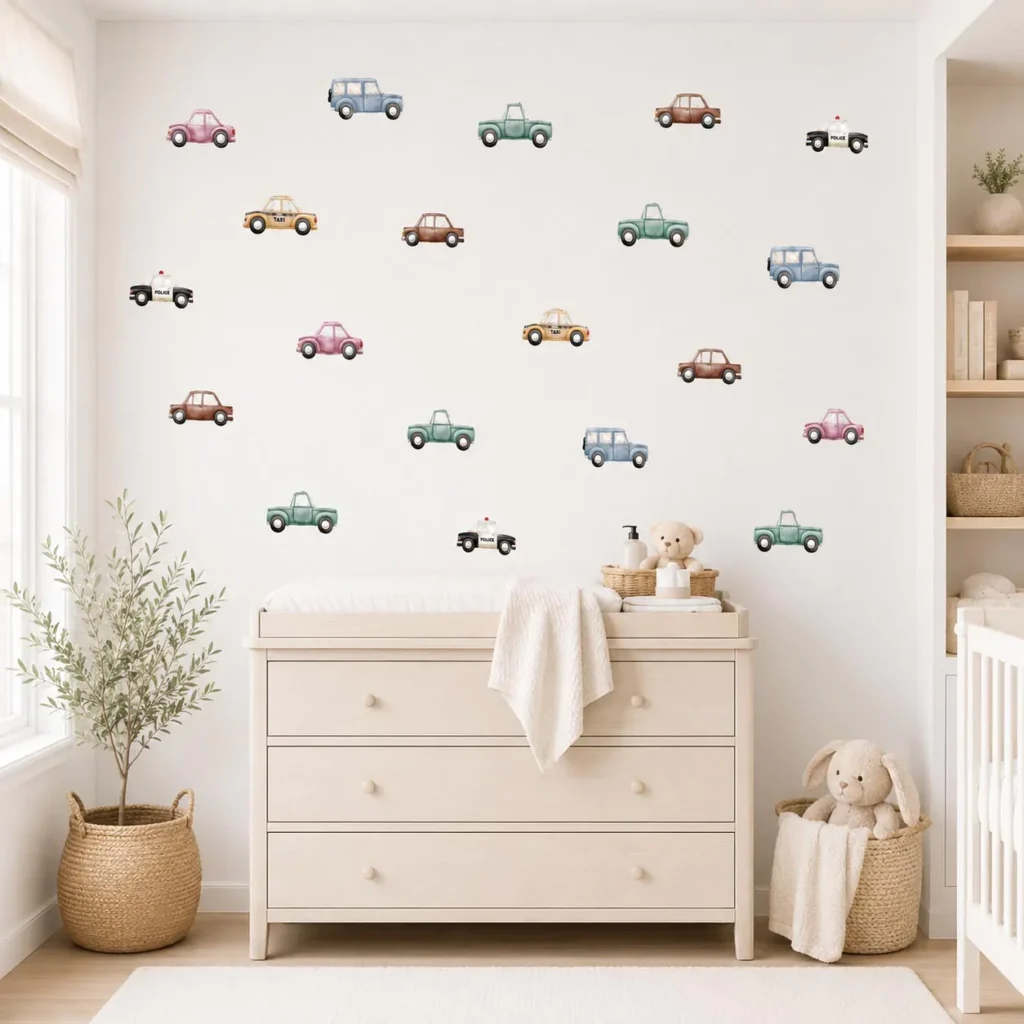
Integrating thoughtfully curated cars wall decor into a child’s personal space directly impacts spatial awareness and object recognition mechanics during early developmental stages. When toddlers observe realistic automotive proportions, their visual cortex processes accurate geometric relationships, depth cues, and mechanical mechanics that exaggerated cartoon figures fail to provide. Modern styling replaces chaotic racing scenes with isolated, text-free vehicle profiles positioned against matte neutral backgrounds. This deliberate reduction of visual noise allows the child to focus on the intricate details of automotive design, such as tire tread patterns and aerodynamic curves, fostering sustained observational focus and calm cognitive engagement without inducing sensory fatigue.
Why text-free minimalist imagery outperforms traditional cartoon graphics
Traditional children’s wallpaper and stickers frequently rely on loud primary colors, anthropomorphic character faces, and bold typographic slogans that quickly feel dated as the child matures. In contrast, text-free minimalist vehicle wall decals maintain an enduring aesthetic relevance that spans from infancy through the pre-teen years. Minimalist designs eliminate unnecessary graphic noise, focusing entirely on the beauty of industrial design and mechanical form. Brands like Dos Junior master this approach by offering realistic, text-free transportation collections that look like hand-painted murals or curated gallery installations rather than commercial merchandise, ensuring the bedroom decor remains timeless and sophisticated.
What placement strategies maximize visual impact for vehicle wall decals?
Strategic placement dictates whether decorative graphics appear as integrated architectural elements or disjointed aftermarket add-ons. When installing vehicle wall decals across residential drywall, interior architects apply classical proportion rules and sightline physics to establish visual balance. A primary error in children’s room decoration is mounting artwork too high on the wall, optimizing the view for standing adults rather than the child inhabiting the space.
To achieve maximum aesthetic cohesion, the primary focal point of the transportation layout should align with the child’s natural eye level, typically sitting between 36 and 48 inches from the finished floor line. When anchoring decals above structural furniture pieces such as toddler beds, dressers, or toy storage consoles, maintain a strict 60% to 75% width ratio relative to the furniture below. This proportional framing prevents the vehicle graphics from overpowering the furniture piece while ensuring the design feels intentionally anchored within the room’s overall geometry.
| Wall Placement Zone | Recommended Vehicle Decal & Layout |
| Near Ceiling / Upper Wall | Train Decals — Horizontal continuous flow across the perimeter |
| 36″ – 48″ from Floor (Child Eye Level) | Truck & Car Decals — Primary focal point above furniture |
| Base / Floor Level | Furniture Baseline (Bed, Dresser, Toy Console) |
Designing high-impact accent walls using trucks wall decor
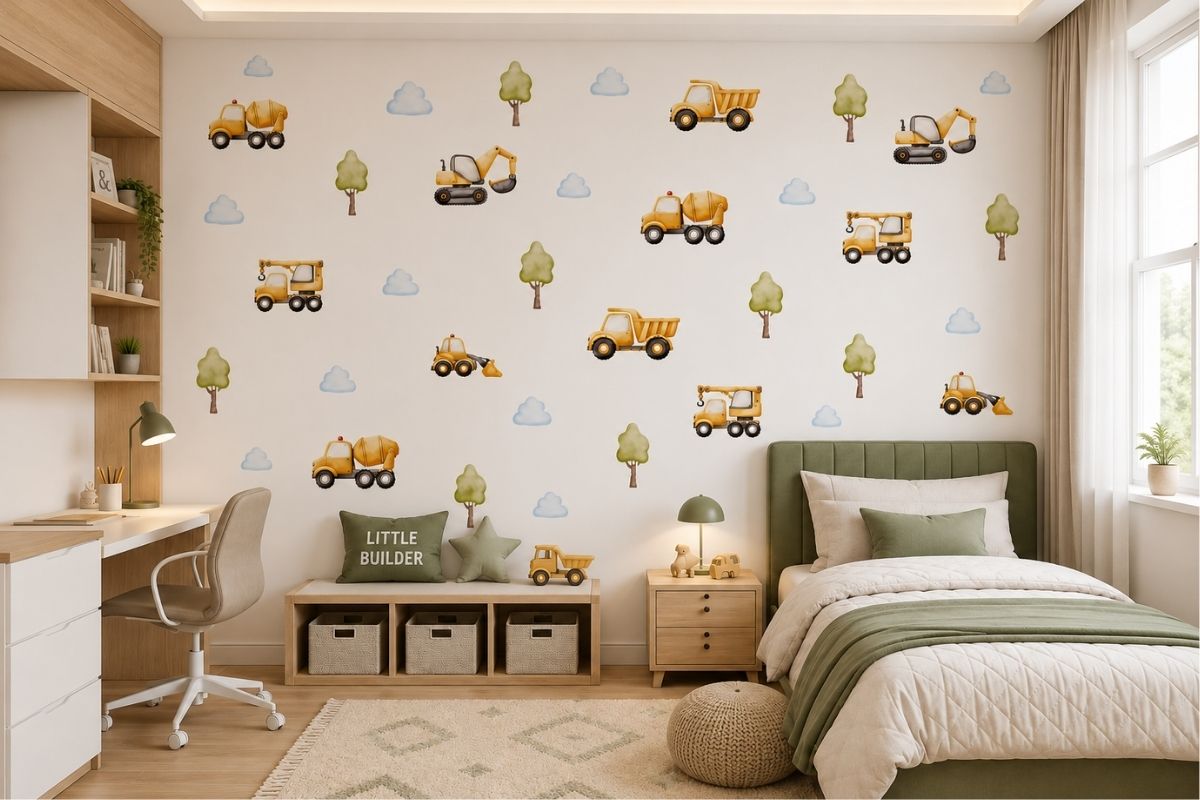
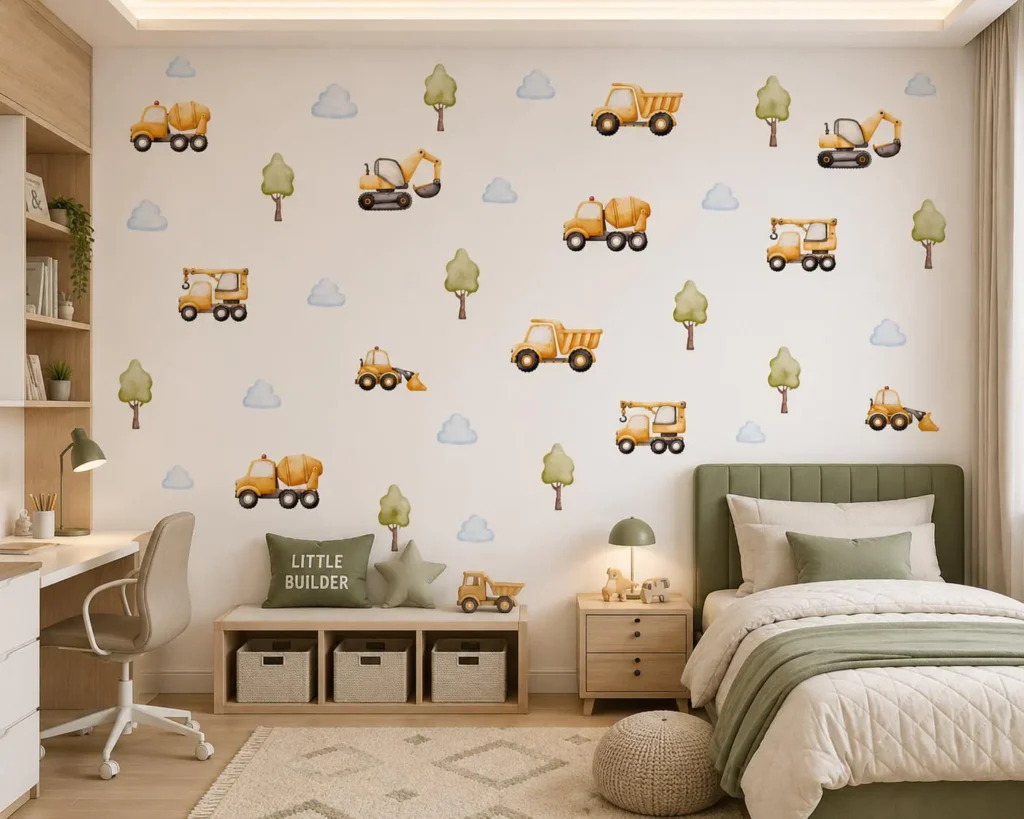
Construction equipment and heavy machinery inherently possess bold, architectural silhouettes that lend themselves perfectly to statement accent walls. When utilizing trucks wall decor, select a single prominent wall—preferably the surface directly opposite the primary doorway or anchoring the headboard—to serve as the structural canvas. Paint the accent wall in a deep, grounding mineral tone such as matte slate grey, forest green, or terracotta, and apply realistic, text-free depictions of excavators, cranes, and dump trucks in natural earth tones. Allowing generous negative space between each machine prevents visual crowding, transforming industrial mechanics into a sophisticated, modern art installation that commands attention without creating clutter.
Creating horizontal motion with train wall decals along baseboards
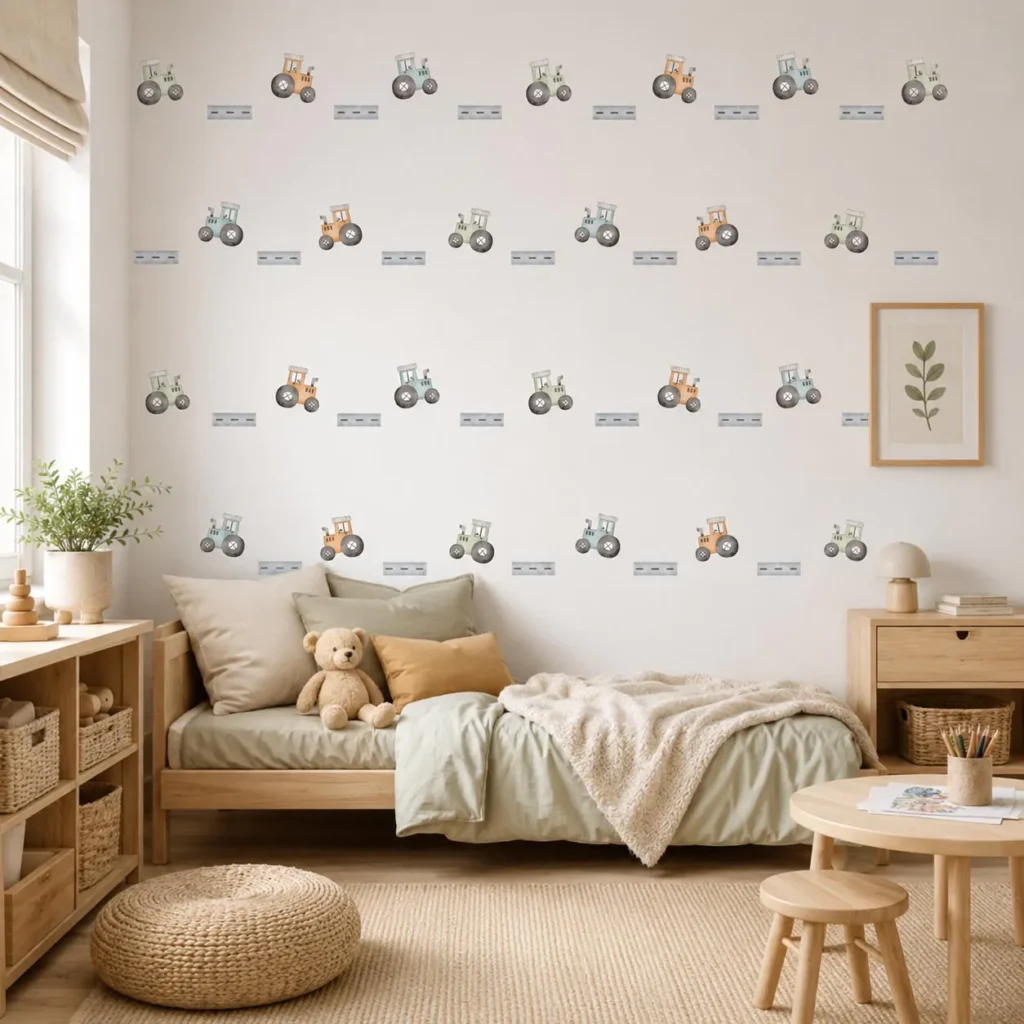
Locomotives and rail systems naturally express linear movement and horizontal continuity, making them exceptional tools for defining architectural boundaries within a bedroom. Installing train wall decals parallel to architectural features—such as directly above wooden baseboards, along wainscoting rails, or trailing across floating bookshelves—creates a dynamic sense of motion that draws the eye smoothly across the room. To maintain a refined modern aesthetic, utilize continuous locomotive silhouettes featuring realistic mechanical detailing and muted color profiles, avoiding broken, erratic placement. This horizontal tracking technique visually elongates smaller bedrooms while establishing an engaging, low-level visual narrative tailored specifically to a playing child’s perspective.
How do fabric vehicle wall decals compare to vinyl in durability?
The physical longevity, indoor safety, and visual quality of vehicle wall decals depend almost entirely on the underlying substrate material and adhesive formulation. The residential decor market is predominantly divided between traditional calendered polyvinyl chloride (PVC) vinyl and premium woven polyester fabric substrates. Understanding the structural and chemical differences between these materials is essential for parents seeking a durable, non-toxic environment.
Calendered vinyl is produced by squeezing molten plastic through heated rollers, resulting in a thin, rigid film that retains internal material memory. Over time, as room temperatures fluctuate, vinyl inevitably attempts to shrink back to its original dimensions, causing unsightly edge curling, seam separation, and adhesive oozing. In contrast, premium woven fabric decals utilize an interlocked polyester fiber matrix that remains dimensionally stable under extreme humidity and thermal variations, guaranteeing flat, seamless wall adhesion for years.
| Material Type | Adhesive Strength | Wall Safe |
| Woven Polyester Fabric | Low-tack microsphere (repositionable) | 100% Yes (Zero residue, no paint peeling) |
| Calendered PVC Vinyl | High-tack solvent-based (permanent) | No (Prone to tearing drywall paper) |
| Cast Vinyl Film | Medium-tack acrylic | Moderate (May leave chemical residue) |
Understanding adhesive chemistry in transportation nursery decor
In closed interior environments like nurseries and children’s bedrooms, adhesive chemistry directly influences indoor air quality. Conventional vinyl decals frequently rely on aggressive solvent-based adhesives that release Volatile Organic Compounds (VOCs), including toluene and xylene, into the ambient air during the first 30 to 90 days after installation. When evaluating transportation nursery decor, strict E-E-A-T standards dictate selecting products utilizing water-based, polyacrylic microsphere adhesives. These advanced adhesives form a temporary mechanical bond with drywall paint rather than a chemical fusion, ensuring zero toxic emissions, complete odor neutrality, and the ability to reposition the graphics multiple times during installation without losing tactile grip.
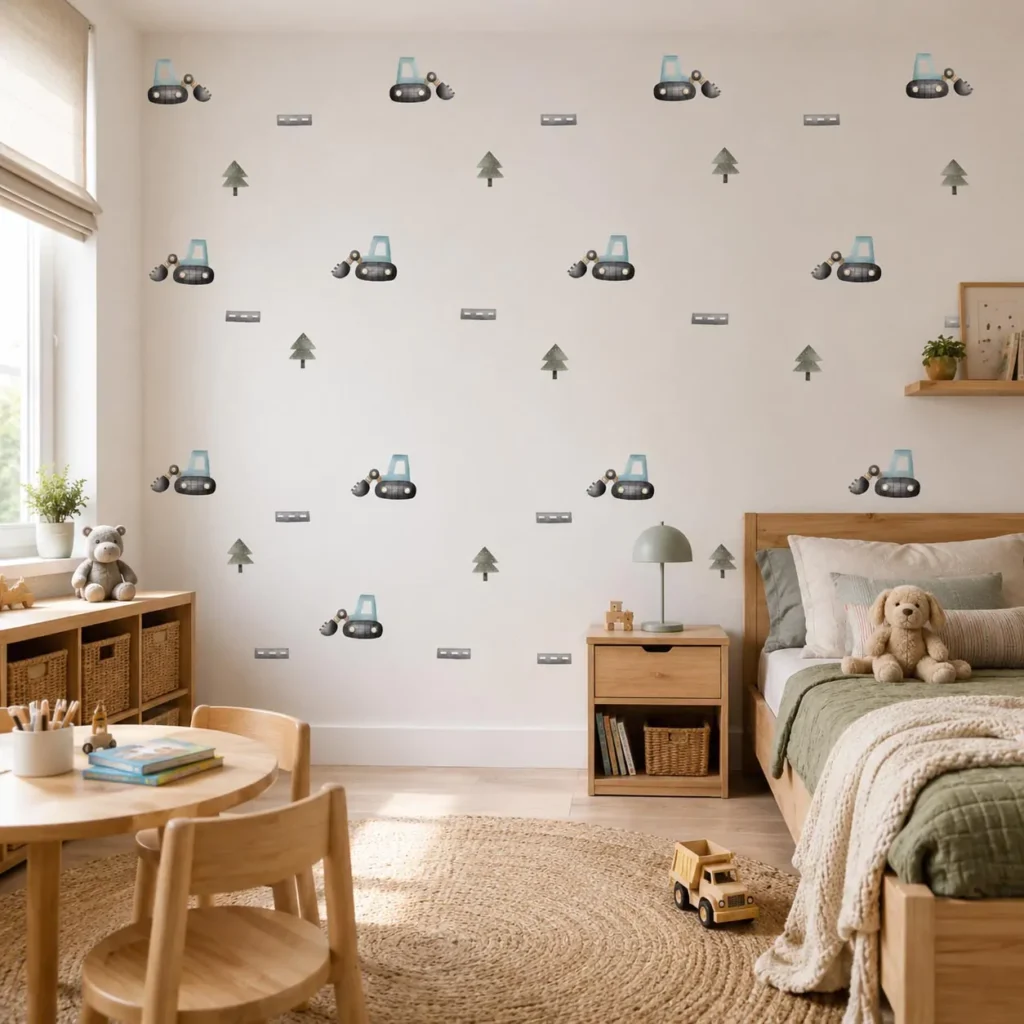
How do you install and remove large vehicle wall decals without damage?
Executing a flawless, professional-grade installation of large-scale vehicle wall decals requires understanding surface physics, thermal dynamics, and mechanical preparation. Even the highest quality woven fabric decals will fail to adhere correctly if applied over contaminated, damp, or improperly cured drywall surfaces. Following a systematic engineering approach ensures perfect adhesion and protects your interior paint investment upon eventual removal.
- Curing and Surface Prep: Allow freshly painted drywall to cure for a minimum of 21 to 30 days prior to decal application; uncured paint releases microscopic water vapor and solvents that get trapped beneath the decal, causing bubbling and adhesive failure.
- Degreasing the Substrate: Wipe the intended installation area thoroughly using a lint-free microfiber cloth dampened with a 70% isopropyl alcohol and 30% distilled water solution to remove residual dust, skin oils, and atmospheric grease without degrading the existing paint sheen.
- Temperature Stabilization: Ensure the ambient room temperature and drywall surface temperature remain stabilized between 18°C and 24°C for 24 hours before and after installation to optimize adhesive wetting and initial tack formation.
- Controlled Application: Peel back the top 4 inches of the silicone release liner, align the decal using a laser level, and apply firm, overlapping strokes using a felt-edge squeegee held at a 45-degree angle, working systematically from the top center outward toward the edges to expel micro-air pockets.
Preparing textured drywall for maximum adhesive bonding
While smooth eggshell or satin drywall finishes provide the ideal bonding substrate, residential walls frequently feature subtle textures such as orange peel, knockdown, or sand finishes. Applying vehicle wall decals over textured drywall requires maximizing the surface contact area between the adhesive layer and the uneven wall topology. For lightly textured surfaces, utilize a heat gun set to low thermal output (approx. 60°C) held 8 inches away from the decal during the final squeegee pass. The gentle thermal elevation softens the woven fabric substrate, allowing the polyester matrix to conform microscopically into the drywall valleys, increasing mechanical surface adhesion by up to 40% without damaging the decal print.
Applying controlled thermal release techniques during removal
When the time arrives to update the bedroom decor or transition to a new developmental phase, removing large vehicle wall decals must be executed with mechanical patience to preserve the underlying drywall face paper. Never pull a decal outward at a 90-degree angle, as this concentrated perpendicular force easily delaminates paint layers and rips drywall drywall gypsum paper.
Instead, initiate removal by lifting a top corner using a plastic scraper and directing a warm stream of air from a standard hair dryer across the decal surface for 30 seconds. The thermal energy temporarily softens the polyacrylic adhesive matrix, reducing its shear bond strength. Slowly peel the graphic backward against itself at a flat 180-degree angle, maintaining steady, continuous tension. This controlled thermal release technique ensures the adhesive remains entirely on the fabric backing, leaving the wall paint pristine and ready for immediate redecorating without requiring sanding or patching.
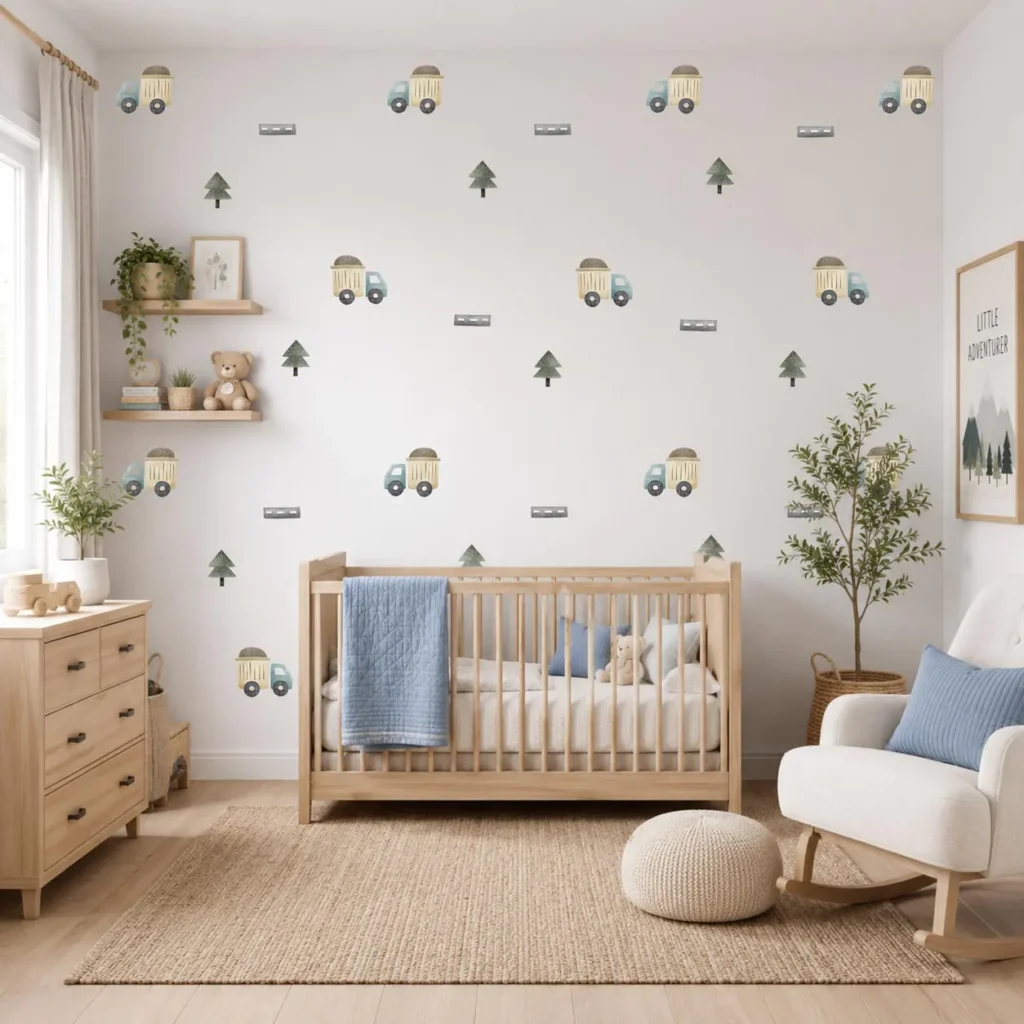
Can you integrate themes like disney cars wall decals with realistic vehicle wall decals?
A frequent dilemma faced by parents decorating a boy’s bedroom is balancing the child’s passionate enthusiasm for commercial entertainment franchises with the parents’ desire for a refined, modern home aesthetic. Many children actively request specific character themes, such as disney cars wall decals, which often feature bright, saturated primary colors and stylized, animated facial expressions. While these commercial graphics bring immediate joy to the child, integrating them directly into a curated, minimalist room can create visual dissonance and aesthetic clutter.
The architectural solution lies in establishing a structured visual hierarchy that blends commercial interests with elevated interior design principles. Rather than plastering entire walls with high-contrast character scenes, interior designers recommend creating a dedicated, framed “imaginative play zone” or reading nook where commercial character graphics are displayed in a controlled, intentional format. The remainder of the bedroom’s perimeter is then adorned with sophisticated, text-free, realistic vehicle wall decals that establish the room’s primary architectural aesthetic. By surrounding saturated character themes with neutral, realistic transportation silhouettes—such as vintage roadsters, detailed architectural bridges, or classic steam trains—parents honor the child’s current interests while maintaining an underlying foundation of modern design stability.
Transitioning from commercial character graphics to timeless realistic silhouettes
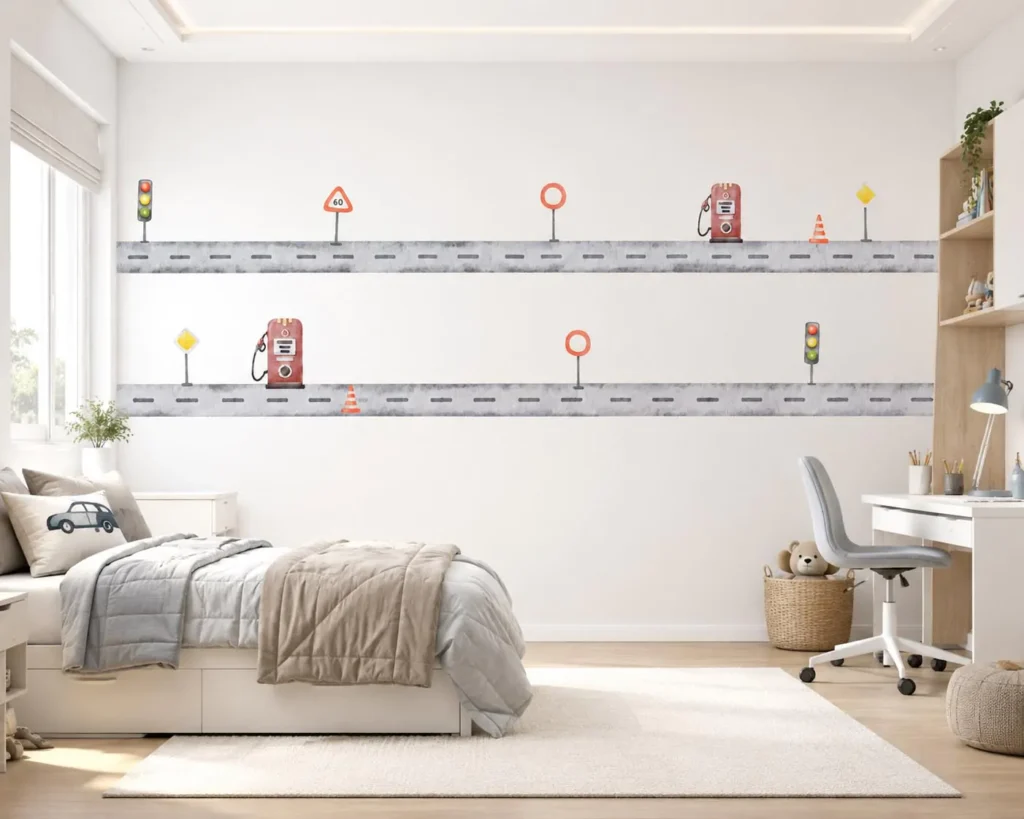
Children’s developmental interests evolve rapidly between the ages of 3 and 8, often causing heavily themed character rooms to feel obsolete within a single design cycle. To maximize financial investment and minimize redecorating labor, adopt a phased transitional styling strategy. Begin by installing a foundational layer of realistic, text-free transportation scenery—such as Dos Junior’s minimalist road networks, detailed mountain silhouettes, or realistic locomotive tracks—crafted from reusable woven fabric.
During the early toddler years, temporary commercial graphics like disney cars wall decals can be applied over or adjacent to these realistic environmental backdrops to satisfy the child’s immediate character fascination. As the child matures and outgrows animated cartoons, the commercial character graphics can be peeled away effortlessly without damaging the underlying scene. The realistic, text-free vehicle silhouettes remain intact, seamlessly transforming the bedroom from a toddler’s playroom into a sophisticated, pre-teen engineering space with zero waste and minimal effort.
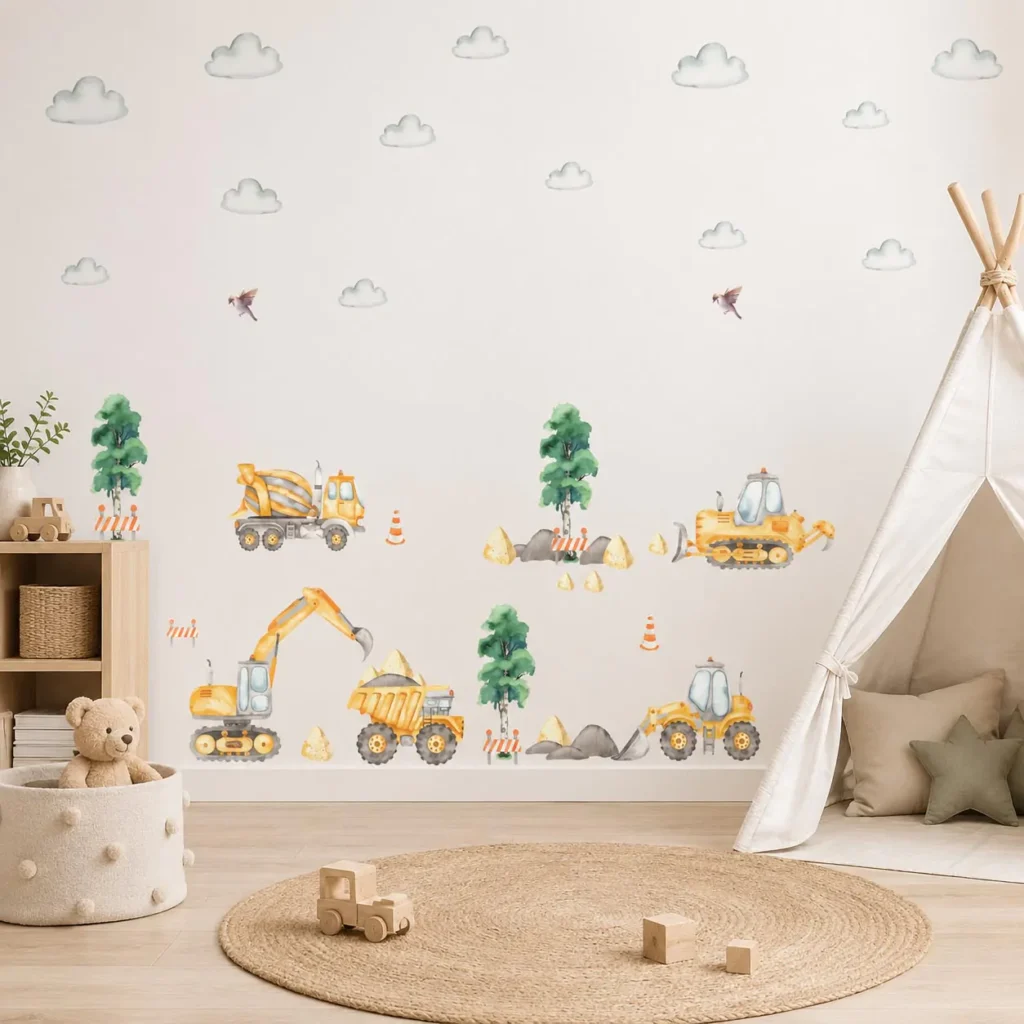
What color palettes and lighting elevate automotive vehicle wall decals?
The visual impact and aesthetic realism of automotive wall art depend heavily on the surrounding chromatic architecture and artificial lighting schemes. A common mistake in transportation-themed rooms is pairing bright, multicolored vehicle decals with stark white or equally saturated primary wall colors, resulting in an exhausting visual environment. Elevated interior design utilizes sophisticated, muted color palettes that draw inspiration from natural landscapes, industrial metals, and classic automotive finishes.
To anchor realistic vehicle wall decals effectively, apply interior wall paints featuring low-reflective matte or eggshell finishes in grounding earth tones. Deep mineral hues—such as charcoal slate, forest moss green, matte terracotta, and warm taupe—create an exceptional high-contrast backdrop that makes realistic automotive graphics pop with three-dimensional depth. Furthermore, integrating natural wood architectural elements, such as walnut shelving or white oak baseboards, softens the industrial hardness of trucks and machinery, infusing the bedroom with organic warmth and textural balance.
Recommended Modern Color Palette for Transportation Rooms
| Color Tone | Recommended Application | Design Purpose & Visual Impact |
| Charcoal Slate | Primary Accent Wall Background | Creates a deep, high-contrast backdrop that makes realistic vehicle graphics pop with 3D depth. |
| Warm Taupe | Secondary Perimeter Walls | Provides a calming, neutral foundation across the room to prevent pre-sleep visual fatigue. |
| Matte Terracotta | Architectural Details & Trim | Adds earthy warmth, bridging the gap between industrial automotive themes and natural wood furniture. |
| Forest Moss | Bedding & Textile Contrast | Introduces a biophilic element through fabrics, balancing mechanical designs with cozy softness. |
When designing the lighting architecture for transportation themes, avoid harsh, high-kelvin cool white lighting (4000K and above), which flattens graphic textures and casts a clinical, institutional glare across wall decals. Instead, install layered lighting utilizing warm, color-correct LED fixtures rated between 2700K and 3000K with a Color Rendering Index (CRI) exceeding 90. Positioning directional dimmable spotlights or LED wall washers at a 30-degree angle relative to the decal surface casts subtle micro-shadows across textured woven fabric, enhancing the photographic realism of wheels, grilles, and mechanical components while establishing a cozy, ambient evening atmosphere conducive to sleep.
Frequently asked questions
How long do woven fabric vehicle wall decals last on bedroom walls?
High-quality woven fabric decals manufactured with polyacrylic microsphere adhesives last between 5 to 7 years indoors without peeling, fading, or shrinking. Unlike PVC vinyl, fabric substrates resist thermal expansion and contraction, maintaining clean edges and vibrant color fidelity throughout your child’s entire early developmental phase.
Can I apply transportation wall decals over freshly painted wallpaper or drywall?
No, you must allow freshly painted drywall to cure for at least 21 to 30 days prior to installation. Uncured paint outgasses moisture and chemical solvents that get trapped under the adhesive, causing structural bubbling and bond failure. For existing wallpaper, ensure the surface is smooth, non-textured, and completely securely bonded.
What makes woven fabric wall decals safer than traditional PVC vinyl stickers?
Woven polyester fabric decals are 100% free of chlorine, phthalates, and harmful Volatile Organic Compounds (VOCs). Unlike PVC vinyl, which releases toxic chemical outgassing into closed bedroom environments, fabric decals utilize water-based, odorless adhesives that comply with strict indoor air quality and pediatric safety standards.
How do I store reusable vehicle decals if we move to a new house?
Gently peel the fabric decal from the wall at a 180-degree angle and apply it smoothly back onto its original silicone-coated release paper. Roll the backed graphic loosely with the design facing outward, store it inside a rigid cardboard mailing tube, and keep it in a temperature-controlled environment between 15°C and 25°C.
Conclusion
Designing an elevated, modern bedroom around transportation themes requires prioritizing visual realism, material safety, and architectural harmony. By moving away from cluttered, cartoonish graphics and embracing clean, text-free vehicle wall decals, parents create an inspiring cognitive environment that respects both childhood imagination and sophisticated home aesthetics. Understanding the decisive superiority of woven polyester fabric over traditional calendered vinyl ensures your interior walls remain undamaged, chemical-free, and dimensionally stable for years.
Whether you are designing a high-impact construction accent wall, establishing horizontal locomotive motion along baseboards, or gracefully transitioning from temporary character fascinations to timeless automotive silhouettes, rigorous preparation and proportional placement guarantee professional results. Explore premium, text-free transportation designs and transform your child’s bedroom today by discovering the realistic, minimalist collections at dos junior collection.